A Struggle Without Borders
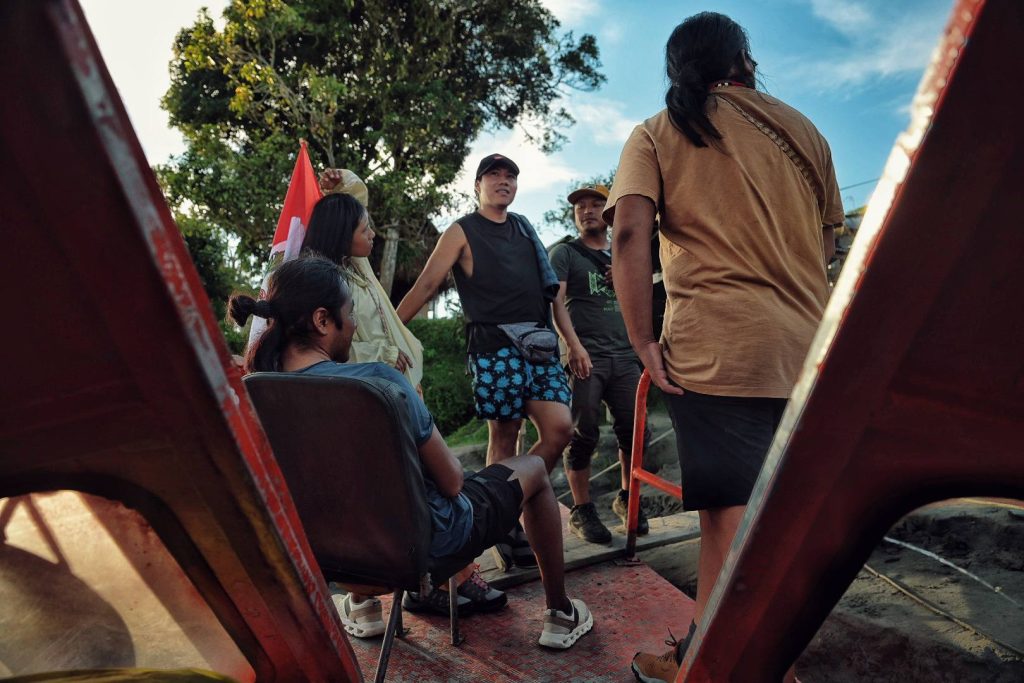
A Struggle Without Borders Logbook of the Second Week of the Yaku Mama Amazon Flotilla on the Road to COP30 Political borders are imaginary lines; rivers, on the other hand, are the living veins that connect a single body. That was the great lesson of our second week on this journey: a voyage that led us across the invisible boundaries between Ecuador, Peru, and Colombia, proving that our struggle—like the water—flows freely, uniting peoples, languages, and hearts. Our ancestors navigated these same rivers. For them, water did not divide: it was the path. Today, on this flotilla, we feel that same connection. We crossed borders that historically fragmented the territories of sibling peoples like the Kichwa, Siekopai, Shuar, and Tikuna. Every transfer between boats, every change of flag, reminded us that we are a single Amazon people defending the same territory: the territory of life. Education as Resistance in the Peruvian Jungle Today, on this flotilla, we feel that same connection. We crossed borders that historically fragmented the territories of sibling peoples like the Kichwa, Siekopai, Shuar, and Tikuna. Every transfer between boats, every change of flag, reminded us that we are a single Amazon people defending the same territory: the territory of life. Since 1975, this institution has been a pioneer in intercultural bilingual education. Here, Kichwa is not just a subject: it is the language in which students learn, dream, and build the future. Students from 29 communities, including the Siekopai, live in a boarding school where they are taught that ancestral wisdom and modern knowledge can walk together. This school is a seed of resistance: a reminder that educating in the language of the territory is also a way of defending it. Technology and Ancestral Guardianship in Vista Hermosa A six-hour navigation brought us, on October 19th, to an island on the Napo River: the community of Vista Hermosa. They were waiting for us on the shore with banners and songs against mining and oil. Their welcome had the strength of those who know what is at stake. As night fell, they shared their greatest achievement with us: a satellite territorial monitoring system, managed by the Kichwa, Ticuna, and Matsés communities themselves, in partnership with ORPIO and Rainforest Foundation US. Using drones, GPS, and satellite alerts, they patrol one million hectares, guarding the forest against logging and extractive invasions. But the most inspiring part is who leads this defense: the women. They organize the patrols, generate the alerts, and have even created “community nurseries” to care for their children while they protect the territory. Vista Hermosa showed us that technology can be a tool of love and guardianship when it is used from the root. Encountering the Great River and the Memory of Rubber That same day, we reached the port of Mazán. After a short trip by mototaxi, it appeared before us: the majestic Amazon River. Although the Napo is immense, the Amazon is on another scale: it is a force that envelops you, reminding you how small you are in the face of its greatness. From there, we continued to Iquitos, the largest river city in Peru, built on a history of exploitation and pain: the rubber boom. Today, its streets and docks preserve the memory of a time of slavery and deforestation, but also the will to heal. Arriving in Iquitos was a milestone: a thousand kilometers navigated, and a deep conviction to transform that memory into justice. The Amazon Venice and the Threat of Flooding On October 20th, we visited the Belén neighborhood, known as the “Amazon Venice.”Its floating houses, its markets of fruits and natural medicines, and its daily rhythm in sync with the river show an admirable adaptation to the pulse of the water. But that pulse is changing. The floods, increasingly extreme due to climate change and deforestation, threaten the lives of thousands of families. Belén is a mirror of the climate crisis: a place where resilience becomes a way of life, even when the threat comes from far away. Cinema, Wisdom, and Indigenous Governance That afternoon, on Muyuna beach, cinema floated alongside us. We participated in a Floating Film Festival, where audiovisual works created by the crew members themselves were screened. It was a moment of collective introspection: seeing ourselves on screen was also recognizing ourselves in the struggles of other territories. On October 21st, we shared a workday with the Regional Organization of Indigenous Peoples of the East (ORPIO). There, visions and strategies intersected: OPIAC from Colombia spoke about territorial monitoring in the face of armed groups; representatives from the Sierra Nevada shared their progress in solar energy; and the Waorani from Ecuador told of their historic resistance to oil in Yasuní. We left those tables with a certainty: living solutions already exist, and they are in our communities. The Triple Frontier and Art as Resistance Between October 22 and 25, we arrived in Leticia, Colombia, the point where the borders of Colombia, Peru, and Brazil dissolve into the river Here, at the Indigenous Cuisine Festival, we shared food, knowledge, and laughter, confirming that the Amazon cultural matrix is one: the jungle that feeds us, heals us, and allows us to exist. We met again with OPIAC, which shared its experience in creating the Indigenous-led Health System and the struggle for the demarcation of reserves. On October 25th, we crossed to the Tikuna Community of San Juan de Barranco, where we were received with the Pelazón ceremony: a ritual that celebrates the transition from girl to woman and honors the continuity of life. That day, Amazon artist Rosi War joined her voice with the community’s in a concert that resonated like a collective song for the jungle. This week taught us that although the threats are global, so is the resistance. We crossed physical borders, but above all, we broke down the borders that separate us.We continue sailing, more united and stronger, towards Belém—where the Amazon will rise to demand that the world listen to the call