COP30

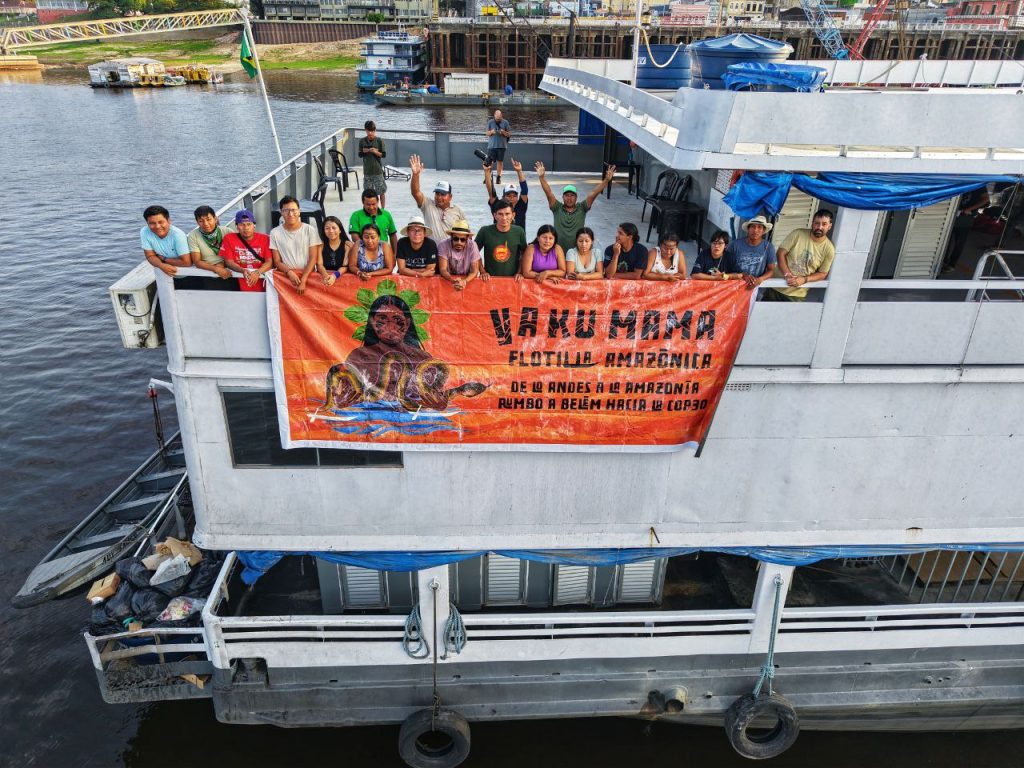
Yaku Mama Flotilla arrives in Belém do Pará for COP30
Destacado, Flotilla

WE ARRIVE AT COP30 WITH A MESSAGE FROM THE HEART OF THE WORLD

WE ARRIVE AT COP30 WITH A MESSAGE FROM THE HEART OF THE WORLD BELÉM DO PARÁ, BRASIL —November 9, 2025. We are the mountain, the rivers, the living jungle. We are the seeds, the trees, the refuge. We are the territory of all lives. We are the Amazon, we are resistance. We are more than 60 leaders and women leaders of Indigenous Peoples from Ecuador, Colombia, Peru, Brazil, Guatemala, Costa Rica, Panama, Mexico, and Indonesia. For one month, we have navigated 3,000 kilometers along the Napo and Amazon rivers—the same waters that centuries ago were a route of conquest—now transforming them into a path of resistance, dignity, and climate justice. We do not come to COP30 to ask for permission. We come to demand that climate policies be built from the territories, with justice for those of us who protect life. OUR JOURNEY During this journey through Ecuador, Peru, Colombia, and Brazil, the river spoke to us. We saw the blood of the earth in the water: rivers poisoned by illegal mining, oil spills that are never cleaned up, and waste that states have ignored for decades. The water—the primary source of life—is being turned into a threat for those who have protected it for millennia. We witnessed the machine of extermination operating without pause: mining, oil companies, logging, and hydroelectric dams, which continue the 500+ years of ecocide and genocide to fuel the consumption of the Global North, the main responsible party for this climate crisis. We saw defenders forced into exile for protecting life. We saw Indigenous youth blocked: without work or spaces for decision-making, forced to migrate. And we saw the most brutal hypocrisy: Brazil, the host of this COP30, is pushing for oil exploration at the mouth of the Amazon River—home to Peoples in Isolation and Initial Contact. In Ecuador, the government is calling for a constituent assembly to repeal the rights of nature. While the world talks about climate action, it criminalizes and murders those who practice it. COP30 cannot continue deciding about us, without us. COP30 cannot continue to decide about us, without us. THE LIVING SOLUTIONS This journey showed us that viable and replicable solutions already exist—they are alive. At every stop, we exchanged monitoring methods, defense strategies, territorial governance systems, and spirituality. We heard different languages naming the same struggles, distinct worldviews defending the same principle: life is sacred and non-negotiable. We learned from peoples who have stopped extractivist projects through collective governance, who have confronted corporations and states, and won. This flotilla is living evidence: peoples from diverse Ancestral Nations flowing as a single river. We bring communication as a tool for territorial defense, creating our own narrative: territorial authorities with their own voice and legitimate governance systems. We bring the clarity that we are the answer. ot as ‘beneficiaries’ of programs designed in distant offices, but as authorities with the right to self-determination. The results speak for themselves: where Indigenous territory is recognized and respected, the jungle stands tall, the water is clean, and biodiversity thrives. WHAT WE DEMAND AT COP30 Without the Amazon, there is no future for humanity. We arrive in Belém with the following demands and proposals, which are common sense in the face of the environmental, economic, political, and spiritual crisis that the entire world is experiencing. 1. AMAZON FREE OF OIL AND MINING We demand the immediate prohibition of fossil fuel exploration and extraction in the Amazon and in all Indigenous territories worldwide. Only an Amazon free of extraction can guarantee the protection of defenders, preserve biodiversity, and ensure global climate resilience. The Amazon is not a resource to be exploited: it is a living being that requires immediate protection. 2. RECOGNITION OF TERRITORIES AS LIVING BEINGS WITH RIGHTS We demand that States legally recognize the Amazon, rivers, and all territories as living entities with their own rights, not as exploitable resources. This recognition must be translated into effective and binding legal protection. 3. INDIGENOUS TERRITORIAL SOVEREIGNTY ABOVE EXTRACTIVE LAWS We demand the recognition of Indigenous authority as legitimate and binding, superseding concessions and state laws that authorize extractivism. The self-determination of peoples cannot be subordinated to corporate or governmental interests. We demand the recognition and guarantee of full territorial rights. 4. REAL FREE, PRIOR, AND INFORMED CONSENT We demand that the energy transition be truly just, respecting Free, Prior, and Informed Consent without simulations or merely decorative consultations. We demand binding—not symbolic—participation in all negotiation spaces that affect our territories. 5. END TO FORCED EXILE AND EFFECTIVE PROTECTION FOR DEFENDERS We demand justice and concrete security guarantees, and an end to impunity regarding threats, assassinations, and criminalization. We demand an end to forced exile that uproots territorial defenders from their communities. States must ensure that those of us who defend the earth can remain peacefully in our communities. 6. BINDING INTEGRATION OF TRADITIONAL KNOWLEDGE We demand what is rightfully ours: that our ancestral knowledge and practices—applied science spanning thousands of years—be recognized and integrated into climate policies as replicable and globally acknowledged solutions, not as ‘folklore’ or ‘customs. 7. DIRECT FINANCING TO THOSE WHO PROTECT LIFE We demand agile climate funds, without intermediaries who profit from our conservation work, and with simplified access for Indigenous youth. The financing must flow directly to our territorial governance systems and to the new generations of defenders. 8. COMPENSATION FOR CLIMATE ADAPTATION AND CLEAN WATER We demand direct compensation so that Amazonian communities can strengthen their adaptation capabilities to a crisis they did not cause. Our territories are facing droughts, floods, and rivers poisoned by mining and oil. Compensation must include water decontamination, waste management, and investment in adaptation systems based on ancestral knowledge. These demands are non-negotiable because we are not negotiating our existence THE ANSWER IS US This flotilla does not end in Belém. It remains organized and ready to fight. We commit to remaining organized after COP30: to sustain communication and coordination among the participating organizations, and to collectively follow up on these demands
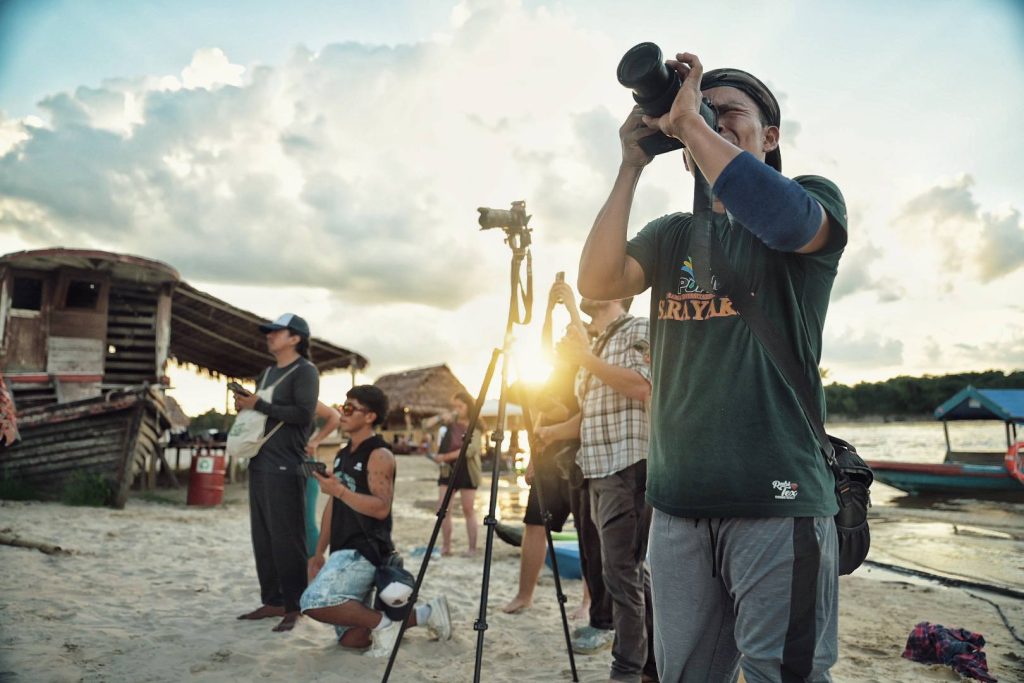
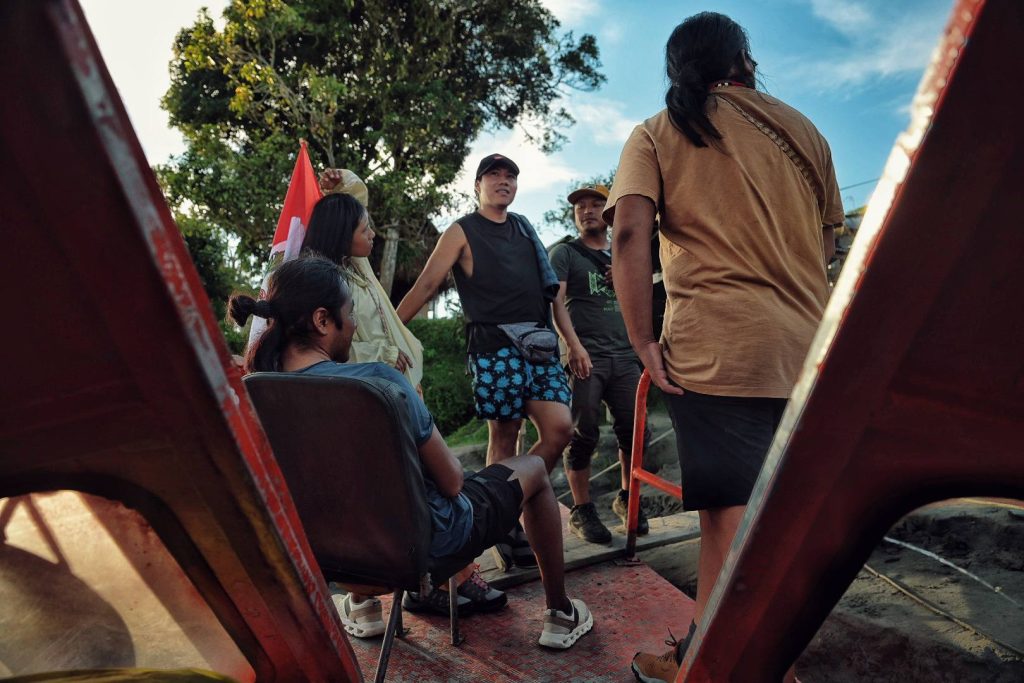
Flotilla participants during filming in Iquitos, Peru
Flotilla, News

Floating Cinema and Audiovisual Creation

Floating Cinema and Audiovisual Creation By: Lucia Ixchiu. We departed from the port of Tabatinga, heading upriver to immerse ourselves in a journey of floating cinema. From Iquitos, and several months prior, the team from the Muyuna collective—a group of artists, filmmakers, and cultural managers who have embraced cinema as a tool for territorial defense—expressed their desire to join and share their work and what they do best: community filmmaking. The day began with a call to a sharing circle where we moved our bodies, danced, and received the first instructions for what would be the start of a process that, for many of the Indigenous youth attending, was their first-ever film workshop. A storytelling exercise allowed us to unite our voices at the beginning of a collective, community-driven, and floating process. This process took place over four of the five days we navigated the Marañón River, with the lush jungle as our backdrop. It was a time of work sessions, dialogue, and learning for the entire flotilla, with everyone participating in one way or another. Cinema, cameras, and all our creativity took over the boat’s top deck. On this vessel, three groups were thinking, writing, and filming their movies, guided by the Muyuna team. On this boat, dreams have been part of the entire journey. Filming and initial edits took shape during the stretch from Tabatinga to Manaus, where the idea of creating a film festival for the flotilla’s audiovisual creations was born. This makes the journey even more inspiring—to tell and narrate our own story from our diversity, from the different languages and biomes that are part of the Yaku Mama. Making dreams come true. For some of the attendees, besides it being their first time leaving their country, it was also the first time they held a camera, a clapperboard, and sound equipment. To dream of using cinema not only to tell our stories but also to create a space to defend our territory.

Yaku Mama Amazon Flotilla arriving in Monterrico - Angoteros, Peru.Photo: Hackeo Cultural
Flotilla, News

A Struggle Without Borders

A Struggle Without Borders Logbook of the Second Week of the Yaku Mama Amazon Flotilla on the Road to COP30 Political borders are imaginary lines; rivers, on the other hand, are the living veins that connect a single body. That was the great lesson of our second week on this journey: a voyage that led us across the invisible boundaries between Ecuador, Peru, and Colombia, proving that our struggle—like the water—flows freely, uniting peoples, languages, and hearts. Our ancestors navigated these same rivers. For them, water did not divide: it was the path. Today, on this flotilla, we feel that same connection. We crossed borders that historically fragmented the territories of sibling peoples like the Kichwa, Siekopai, Shuar, and Tikuna. Every transfer between boats, every change of flag, reminded us that we are a single Amazon people defending the same territory: the territory of life. Education as Resistance in the Peruvian Jungle Today, on this flotilla, we feel that same connection. We crossed borders that historically fragmented the territories of sibling peoples like the Kichwa, Siekopai, Shuar, and Tikuna. Every transfer between boats, every change of flag, reminded us that we are a single Amazon people defending the same territory: the territory of life. Since 1975, this institution has been a pioneer in intercultural bilingual education. Here, Kichwa is not just a subject: it is the language in which students learn, dream, and build the future. Students from 29 communities, including the Siekopai, live in a boarding school where they are taught that ancestral wisdom and modern knowledge can walk together. This school is a seed of resistance: a reminder that educating in the language of the territory is also a way of defending it. Technology and Ancestral Guardianship in Vista Hermosa A six-hour navigation brought us, on October 19th, to an island on the Napo River: the community of Vista Hermosa. They were waiting for us on the shore with banners and songs against mining and oil. Their welcome had the strength of those who know what is at stake. As night fell, they shared their greatest achievement with us: a satellite territorial monitoring system, managed by the Kichwa, Ticuna, and Matsés communities themselves, in partnership with ORPIO and Rainforest Foundation US. Using drones, GPS, and satellite alerts, they patrol one million hectares, guarding the forest against logging and extractive invasions. But the most inspiring part is who leads this defense: the women. They organize the patrols, generate the alerts, and have even created “community nurseries” to care for their children while they protect the territory. Vista Hermosa showed us that technology can be a tool of love and guardianship when it is used from the root. Encountering the Great River and the Memory of Rubber That same day, we reached the port of Mazán. After a short trip by mototaxi, it appeared before us: the majestic Amazon River. Although the Napo is immense, the Amazon is on another scale: it is a force that envelops you, reminding you how small you are in the face of its greatness. From there, we continued to Iquitos, the largest river city in Peru, built on a history of exploitation and pain: the rubber boom. Today, its streets and docks preserve the memory of a time of slavery and deforestation, but also the will to heal. Arriving in Iquitos was a milestone: a thousand kilometers navigated, and a deep conviction to transform that memory into justice. The Amazon Venice and the Threat of Flooding On October 20th, we visited the Belén neighborhood, known as the “Amazon Venice.”Its floating houses, its markets of fruits and natural medicines, and its daily rhythm in sync with the river show an admirable adaptation to the pulse of the water. But that pulse is changing. The floods, increasingly extreme due to climate change and deforestation, threaten the lives of thousands of families. Belén is a mirror of the climate crisis: a place where resilience becomes a way of life, even when the threat comes from far away. Cinema, Wisdom, and Indigenous Governance That afternoon, on Muyuna beach, cinema floated alongside us. We participated in a Floating Film Festival, where audiovisual works created by the crew members themselves were screened. It was a moment of collective introspection: seeing ourselves on screen was also recognizing ourselves in the struggles of other territories. On October 21st, we shared a workday with the Regional Organization of Indigenous Peoples of the East (ORPIO). There, visions and strategies intersected: OPIAC from Colombia spoke about territorial monitoring in the face of armed groups; representatives from the Sierra Nevada shared their progress in solar energy; and the Waorani from Ecuador told of their historic resistance to oil in Yasuní. We left those tables with a certainty: living solutions already exist, and they are in our communities. The Triple Frontier and Art as Resistance Between October 22 and 25, we arrived in Leticia, Colombia, the point where the borders of Colombia, Peru, and Brazil dissolve into the river Here, at the Indigenous Cuisine Festival, we shared food, knowledge, and laughter, confirming that the Amazon cultural matrix is one: the jungle that feeds us, heals us, and allows us to exist. We met again with OPIAC, which shared its experience in creating the Indigenous-led Health System and the struggle for the demarcation of reserves. On October 25th, we crossed to the Tikuna Community of San Juan de Barranco, where we were received with the Pelazón ceremony: a ritual that celebrates the transition from girl to woman and honors the continuity of life. That day, Amazon artist Rosi War joined her voice with the community’s in a concert that resonated like a collective song for the jungle. This week taught us that although the threats are global, so is the resistance. We crossed physical borders, but above all, we broke down the borders that separate us.We continue sailing, more united and stronger, towards Belém—where the Amazon will rise to demand that the world listen to the call

Scroll to Top
Privacy Overview

This website uses cookies so that we can provide you with the best user experience possible. Cookie information is stored in your browser and performs functions such as recognising you when you return to our website and helping our team to understand which sections of the website you find most interesting and useful.