From the Andes to the Amazon: The First Steps of the Yaku Mama Amazonian Flotilla’s Journey
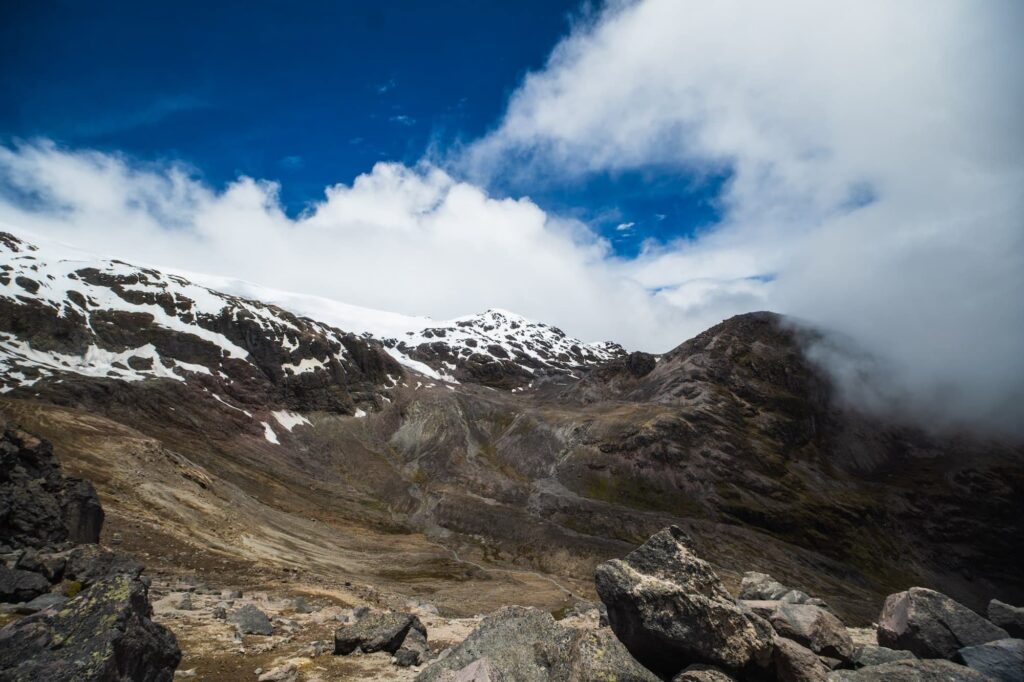
Quito, the Ecuadorian capital located at the center of the world, high in the Andes Mountains. Belém, the capital of the state of Pará, Brazil, situated on the Amazon River as it flows towards its mouth in the Atlantic Ocean. More than 3,000 km not only measure the distance between these two points on a map but also encompass the diverse habitats of biological diversity and the cultural coexistence of Indigenous peoples and nationalities of South America, from the peaks of the glaciers to the depths of the Amazon.
Our goal is to reach COP30, the UN Climate Change Conference. This year, it will be held in Belém do Pará. The starting point of our journey is Quito. Along our route, we are documenting with the intention of making visible the problems of mining, oil exploitation, deforestation, climate change, and their environmental impact on our communities.
Our path is guided by the flow of water, from glaciers and high-altitude páramos to the dense Amazon rainforest, in a vital cycle from which we take our name: Amazon Flotilla Yaku Mama.
We began the river journey in the port city of Francisco de Orellana, better known as El Coca. This choice had symbolic value, as it was from this very point on February 12, 1542, that the boats of the colonizer who gave the city its name set sail.
Today, at this same latitude, over 60 Indigenous and nature defense organizations are setting out with the intention of confronting our colonial and extractivist past, to transform the pain of devastation into collective action.
“This flotilla is not just a protest; it is a living message sailing through the veins of the Amazon. The river itself shows us its scars: the oil slicks, the wound of mining. We are not just coming to bring a problem to COP30; we are coming to present the solutions that our peoples and the forest have cultivated for millennia.” – Alexis Grefa, a young Kichwa Amazonian from Ecuador.
As the Yaku Mama Amazon Flotilla, we sail with a collective call for Climate Justice on our way to COP30, the most significant international event under the United Nations Framework Convention on Climate Change (UNFCCC). Our message is clear: the era of fossil fuels in the Amazon must end. We do not want the Amazon to become a new sacrifice zone.
From the Cayambe Glacier to the Amazon River
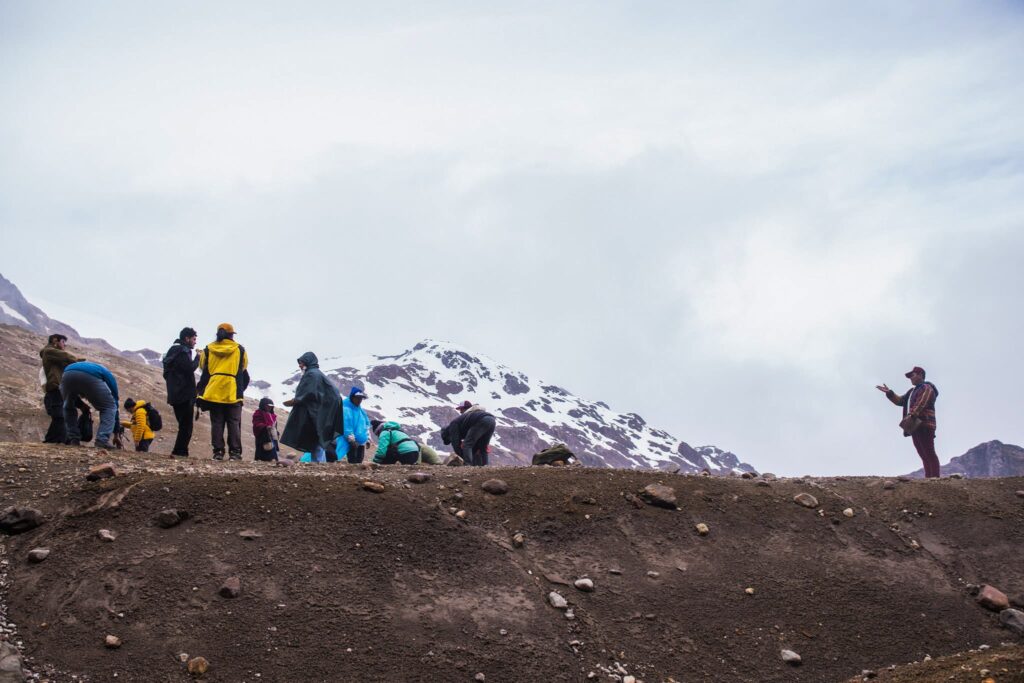
“Glaciers, rivers, and the rainforest are not separate worlds. They are a single body, a Sacred cycle that sustains life.” – Leo Cerda, Indigenous leader and activist
October 9. Cayambe, Pichincha, Ecuador.
The first point of the expedition was the Cayambe Volcano, at over 4,600 meters above sea level in the Andes Mountains of Ecuador. Even here, so far from populated centers, in a space that appears purely natural and even inhospitable to humans, the effects of climate change are visible: the snow recedes year after year, and the glacier’s surface area has shrunk. Other glaciers in the region are suffering the same fate. According to a report by the MapBiomas Water initiative, between 1985 and 2022, 184,000 hectares (56%) of glacier surface area were lost in the Amazon countries.

The loss of glaciers has a direct impact on altering rain cycles, soil degradation, and access to water, which makes the populations dependent on these ecosystems vulnerable. It is also a clear sign of global warming; without ice and glaciers, the planet will lose its reserves of water, a basic element for life.
It is significant that our journey symbolically begins here, an invitation to reflect on the impact of environmental damage in the region. It invites us to understand how two apparently separate worlds are connected: the Sierra (Andes Mountains) and the Amazon. From glaciers like Cayambe comes the water that feeds the rainforest, flowing all the way to the Amazon River before returning to the highlands in a sacred cycle.
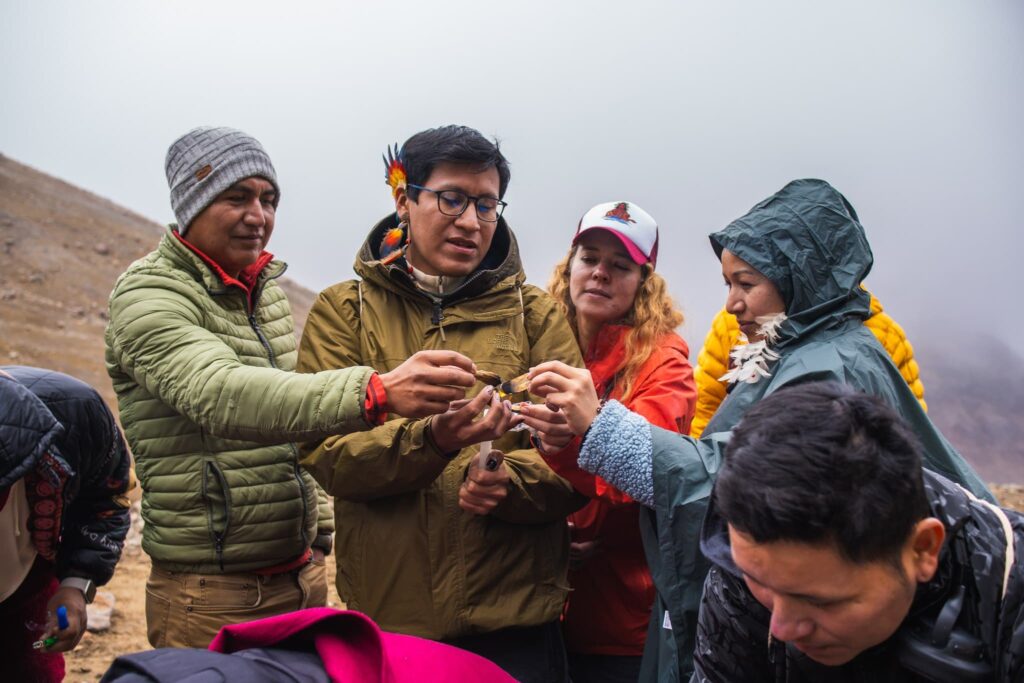
On top of Mama Cayambe, a sacred huaca for the Andean Kichwa peoples, we held an ancestral ceremony focused on the importance of glaciers, the Andean páramos, and their connection to the Amazon. Here, we also raised a message calling for awareness that this cycle is threatened by deforestation and climate change. We began our journey after greeting and gathering the energy and strength of the Indigenous peoples of the Andescommunities in resistance like the Kayambi, Otavalo, Natabuela, and Karanki.
We visited emblematic sites in the city of Quito, rested, and organized the logistics and luggage for our overland trip to descend from the Andes to the Amazon.
Anti-Hegemonic Narratives and Amazon Youth in Defense of the Amazon from Climate Change
October 13. Serena, Napo, Ecuador.
From the heights of the páramos and the cold mountain wind, we headed to the heart of the Kichwa Amazonian territory in the Napo province. We followed a road that runs along the riverbank until we reached a pedestrian bridge that leads to the community of Serena.
We began the day with a welcoming ceremony, introductions, and giving thanks to the elements. The community received us with a traditional breakfast in the warmth that characterizes humid tropical climates, setting the tone for our journey to Belém.
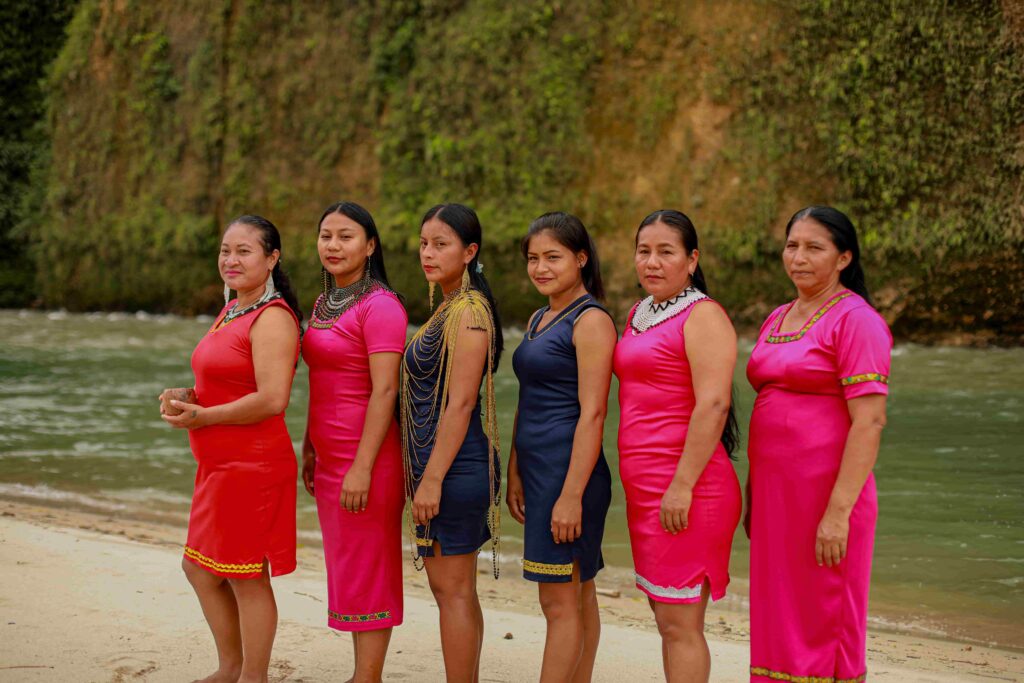
Serena is renowned for its activism and leadership in territorial defense and climate action. This region has been affected by gold mining, which causes forest destruction, contamination of water sources, and ecosystem degradation. Among Serena’s most recognized initiatives are the World Indigenous Youth Forum on Climate Change and the Yuturi Warmi Indigenous Guard, the latter led by over 40 Indigenous women.
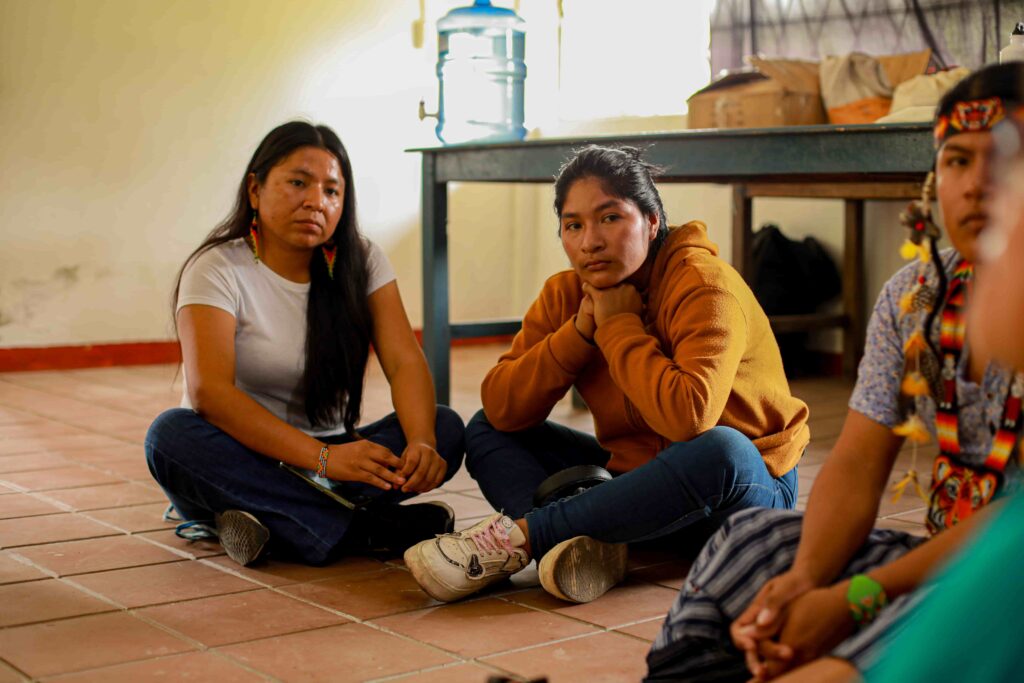
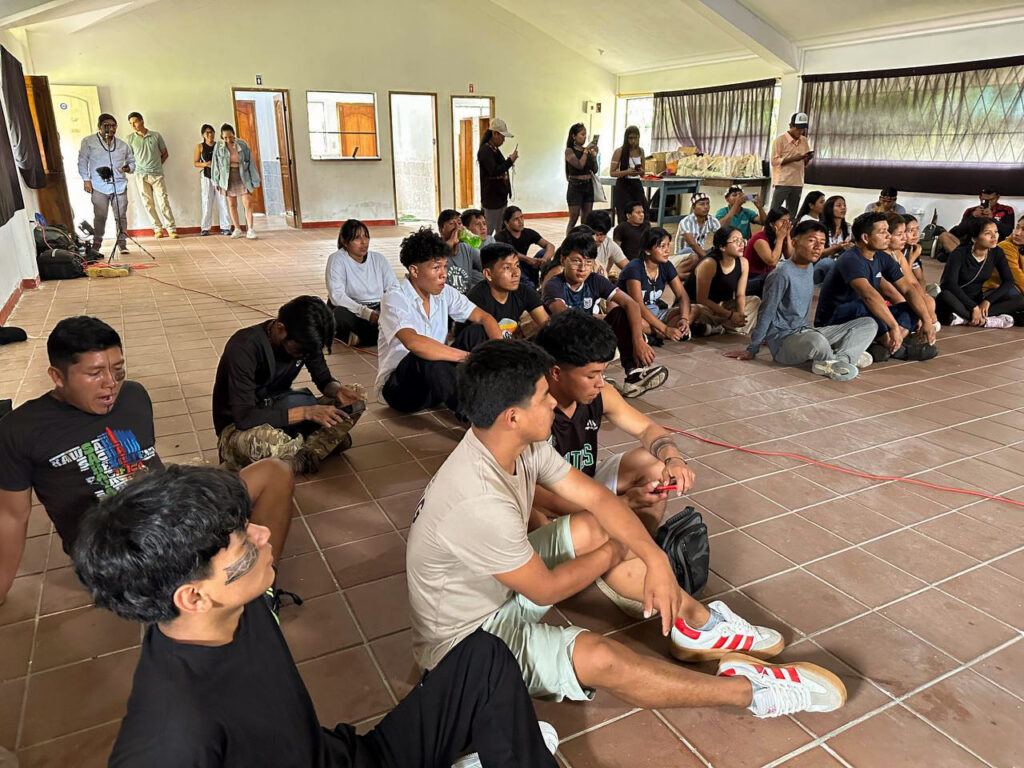
Here, we participated in the Workshop: “Anti-Hegemonic Narratives and Amazonian Youth in Defense of the Amazon from Climate Change.” It was a space for collective creation to devise strategies that allow us to transform words and art into tools for defending our territory, culture, and life.
We developed reflections that allow us to see our personal, community, territorial, and environmental histories as intertwined spheres that enable us to create cross-border connections and organizational strategies.
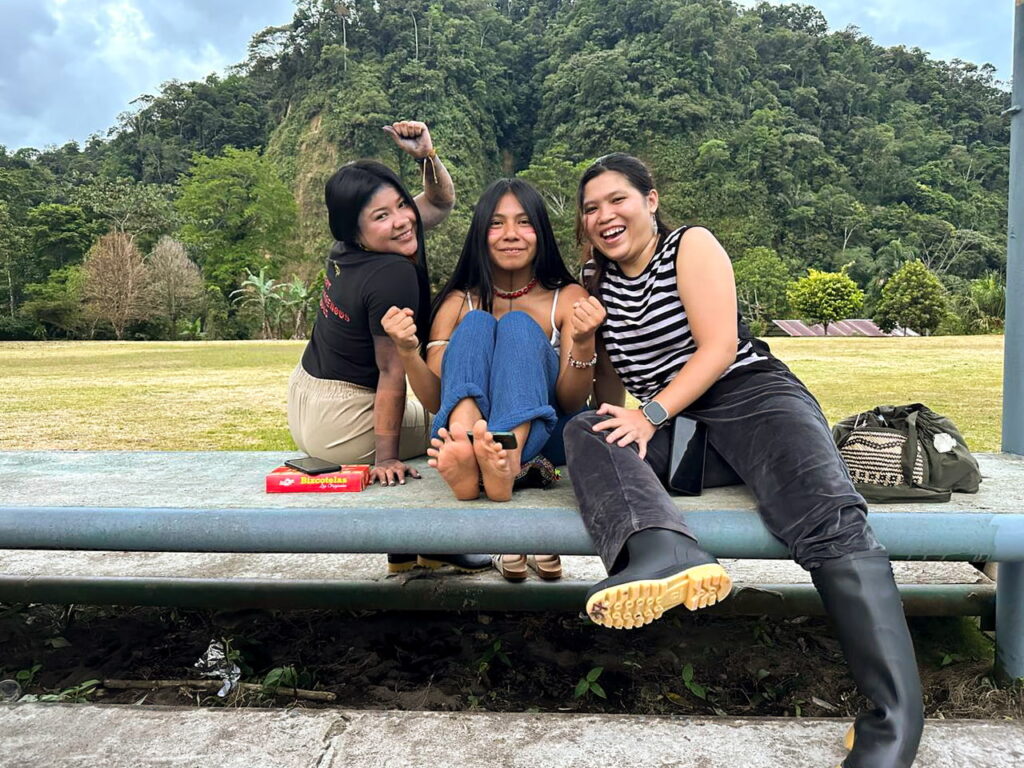
The gathering was hosted and led by the women of Yuturi Warmi, along with communicators and artists who told us about their fight against mining and all forms of invasion of their ancestral territories. It was the first meeting to share the diverse issues affecting all our communities, with participating delegations from Ecuador, Colombia, Guatemala, Mexico, Brazil, and Panama.
Illegal Mining and Women Leaders
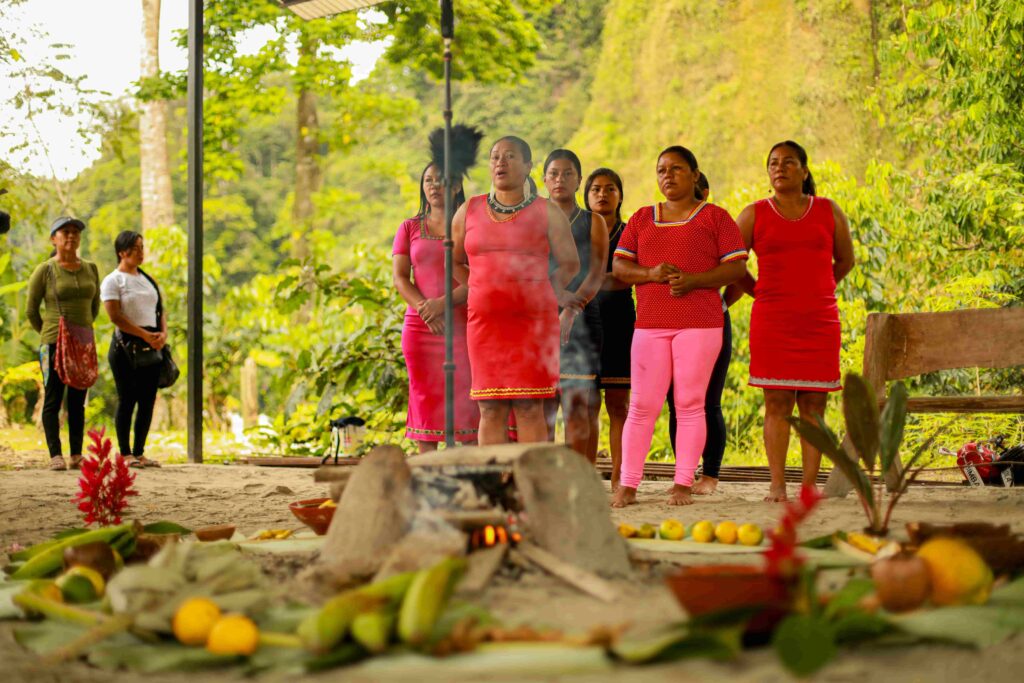
In Serena, our crew also entered the territory of the Jatun Yaku River, where they tested their rafting skills in its waters. Additionally, we were able to take a tour to witness firsthand the impacts of gold mining on the rivers and Amazonian communities.
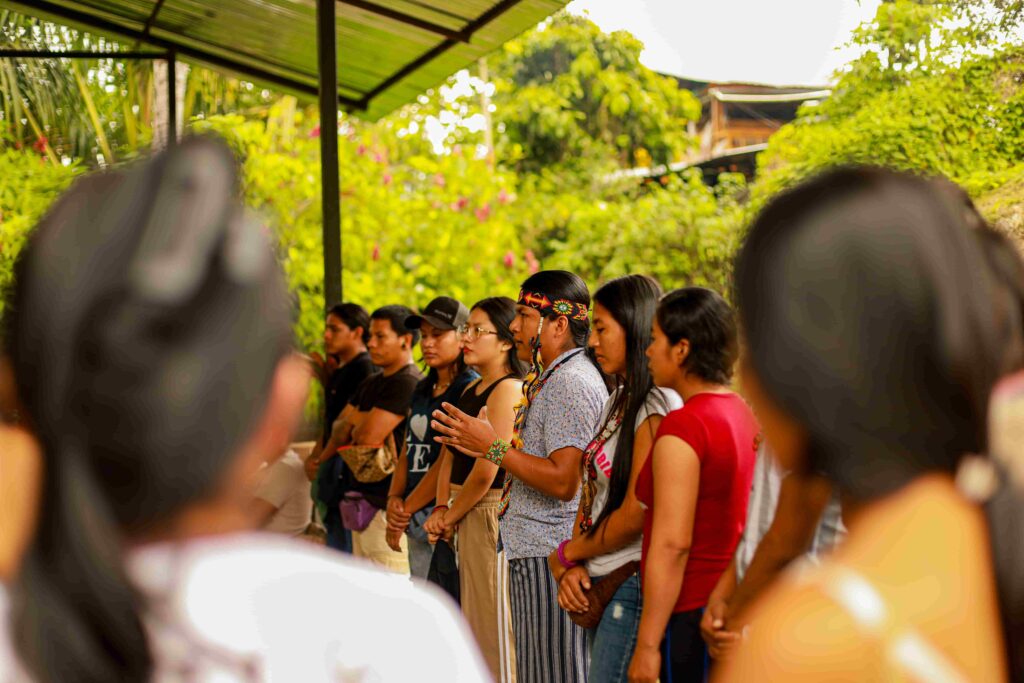
Afterward, we participated in the Forum: “Illegal Mining in Napo, Women, and Resistance.” This space allowed the community’s youth to raise their voices and express their demands against the advance of extractivist activities and their harmful environmental effects.
An example of this is deforestation. In the Upper Napo River region, more than 500 hectares have been deforested since 2017 as a direct consequence of mining activities, and in 2024, another 204 affected hectares were reported. This has led to heavy metal contamination and sedimentation, affecting Indigenous communities, wildlife, and protected areas.
After a day of intense activity, we left the Community of Serena, carrying with us the lessons from the Yuturi Warmi and their voice of resistance, as we headed to the city of El Coca, from where we would set sail on the Napo River towards Belém.
Oil Contamination and Community Organizing: The Toxic Tour and UDAPT
October 14. Francisco de Orellana, Ecuador.
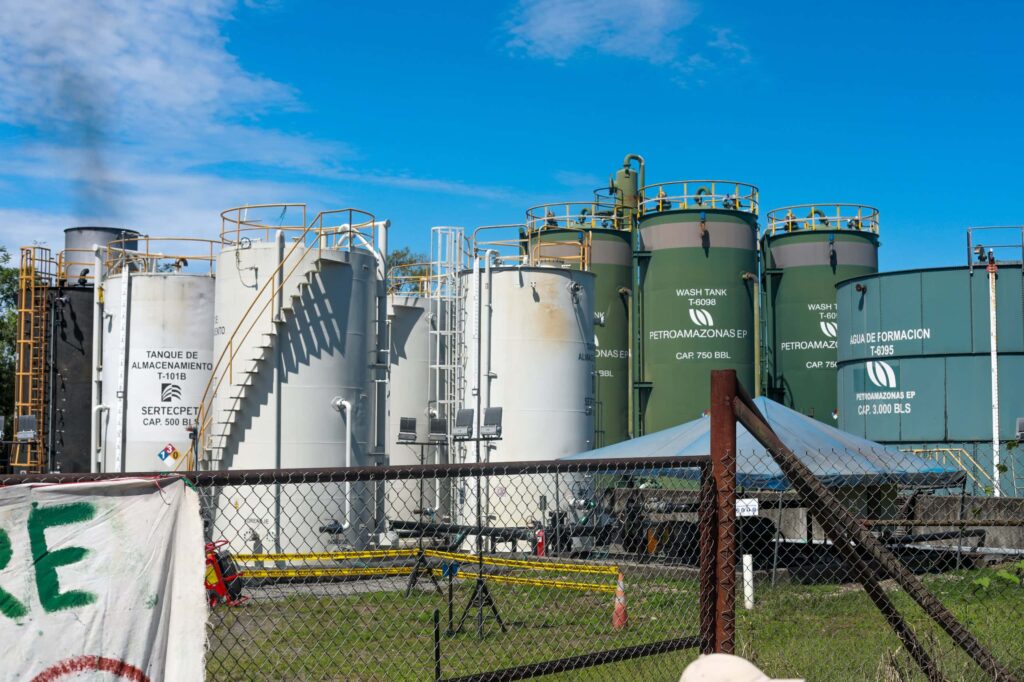
We toured communities and hamlets around the city of Francisco de Orellana, popularly known as El Coca, conducting a TOXIC TOUR to identify the environmental impacts left by oil extraction since the 1970s. This initiative was created in 2003 to give greater visibility to the real impacts that oil companies leave behind after their operations.
We were guided by Donald Moncayo, spokesperson for the Union of People Affected by Texaco’s Oil Operations (UDAPT). This organization carries out legal work and academic studies on the impacts of oil extraction. It is an association whose members include 6 Indigenous nationalities—Waorani, Siekopai, Siona, A’I Kofan, Shuar, and Kichwa—and about 80 mestizo peasant communities, all inhabitants of the Ecuadorian Amazon.
This unity in the face of a common affliction shows us that a solution to the climate crisis is popular social organization among various nationalities, ethnic groups, and mestizo peasants. It is an example of how we are all equally affected by river water pollution, air pollution, and acid rain as inhabitants of the same territory. Likewise, all the contamination generated is recognized as the direct responsibility of extractive companies and government negligence.
This organizational model allows us to reflect that beyond ethnicity, we are all affected by an extractivist model. Our strength lies in organizing and uniting as inhabitants of the same watersheds, ecosystems, and ultimately, as earthlings who depend on our planet and its biodiverse complexity for sustenance.
UDAPT has won lawsuits against the transnational corporation Texaco, now Chevron, for the environmental damages caused by its oil operations between 1964 and 1990.
“Texaco drilled 356 oil wells in an area of 480,000 hectares, where there are 880 pits with no protection such as geomembranes, concrete, or even plastic. They are simply filled with crude oil. These pits were built near freshwater aquifers, which are contaminated because the rain would fill and overflow the pits.” – UDAPT Website
Among the most harmful consequences is an increase in cancer cases, especially cervical and skin cancer, and damage to digestive system organs. Several companions shared their experiences of having family members with catastrophic illnesses.
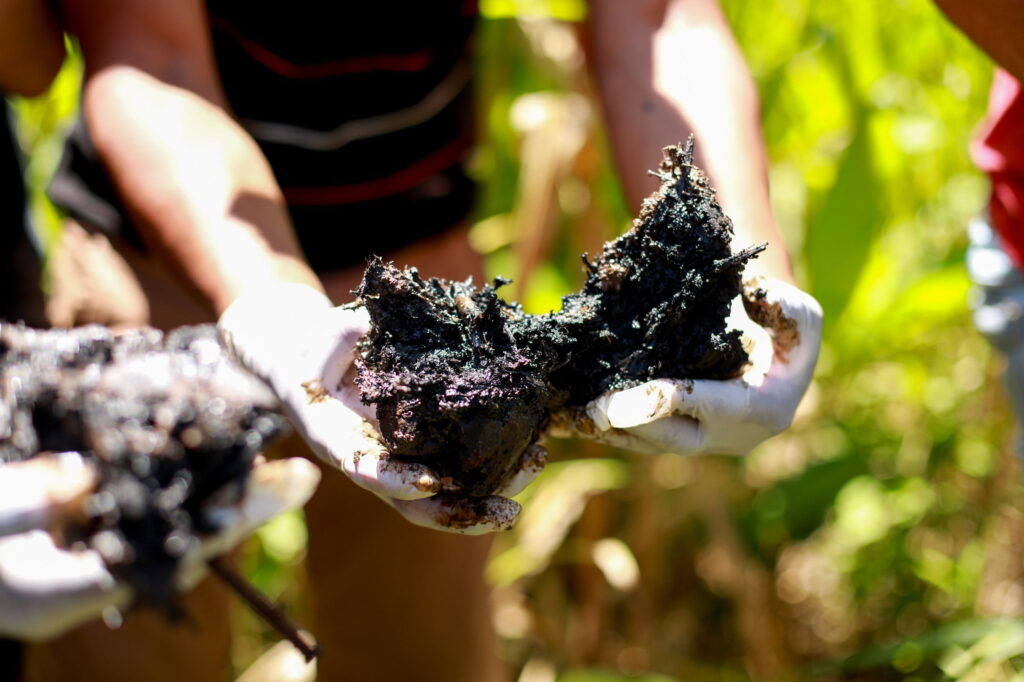
We visited sites where formation waters—a mix of crude oil with other minerals, including water—were discarded and dumped directly onto the land. More than 40 years have passed since the first extractions, and to this day, digging just two or three shovelfuls reveals black stains in the soil. This demonstrates the negligence of the companies that carried out this work, as well as the Ecuadorian state, which fails to provide health centers or ways to compensate for the damages the population has suffered.
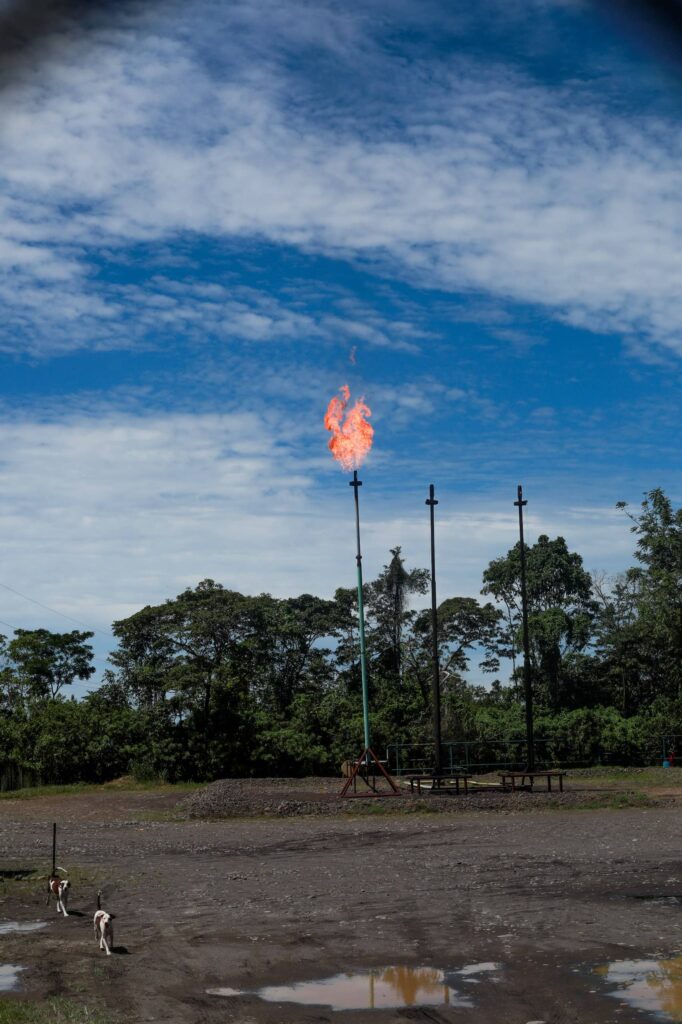
We also toured areas where we saw the infamous gas flares, large structures that channel the natural gas released from oil wells to be incinerated. They primarily damage the air, generating smoke and ash. The surrounding area is affected as insects and other jungle animals, attracted by the light, end up incinerated.
The smoke released by the flares condenses and, during precipitation, turns into acid rain, which destroys vegetation, animals, and infrastructure, and contaminates crops, clothing, and everything exposed to rainwater.
“Rainwater is contaminated by the flares, and there are still 322 communities in the Amazon that do not have potable water,” Moncayo told us, demanding the shutdown of the flares: “We call on world leaders for an ecological transition as the only alternative to curb climate change.”
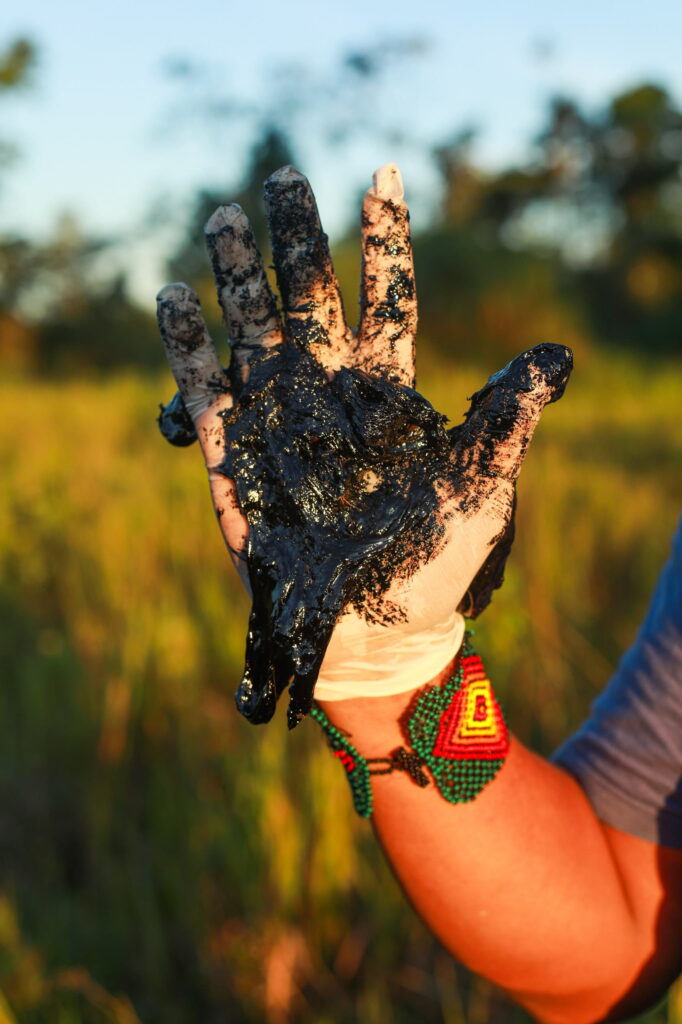
We concluded the tour with a talking circle where we shared our impressions of so much devastation. With heavy hearts, the chiefs from Oiapoque (Amapá state), from the Brazilian delegation, shared their thoughts. Witnessing this emblematic fight against oil exploitation encouraged them, as they face the same threat in their territory from the expansion of the Petrobrás company.
The Fossil Fuels Funeral
October 15. El Coca, Ecuador.
Filled with impressions from the toxic tour, the next morning our Yaku Mama Flotilla crew participated in a forum: “The End of Fossil Fuels” and the symbolic action “Funeral for Fossil Fuels.” In the first part, we heard a detailed presentation on the damage caused by the expansion of oil exploitation in the Amazon, as well as words from leaders from different parts of the Ecuadorian, Peruvian, Colombian, and Brazilian Amazon.
According to the media outlet InfoAmazonia and the Arayara International Institute, which works on environmental defense, oil extraction affects 441 ancestral territories and 61 protected natural areas, devouring the jungle and directly threatening the life and self-determination of Indigenous peoples. Furthermore, between 2000 and 2023, Peru recorded 831 oil spills, and Ecuador recorded 1,584 between 2012 and 2022.
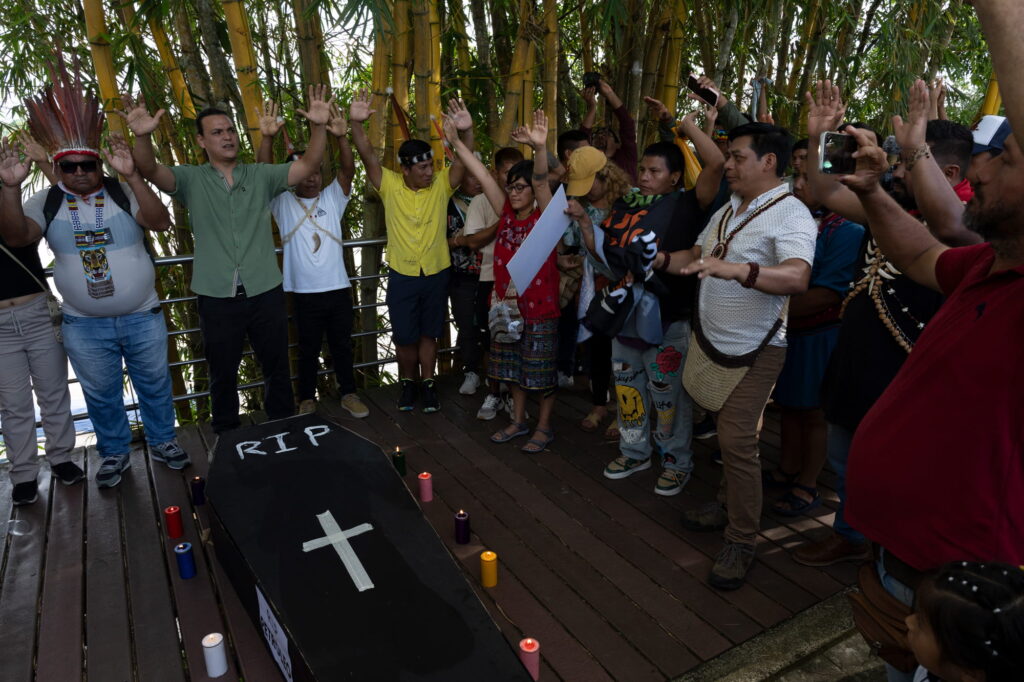
Once again, after hearing about the environmental problems, our flotilla performed symbolic acts to purify ourselves and receive strength and energy to help with our main purposes: to make visible the impacts of this extractivist expansion and, at the same time, to demand the cessation of oil activities in the territories of the Amazon peoples.
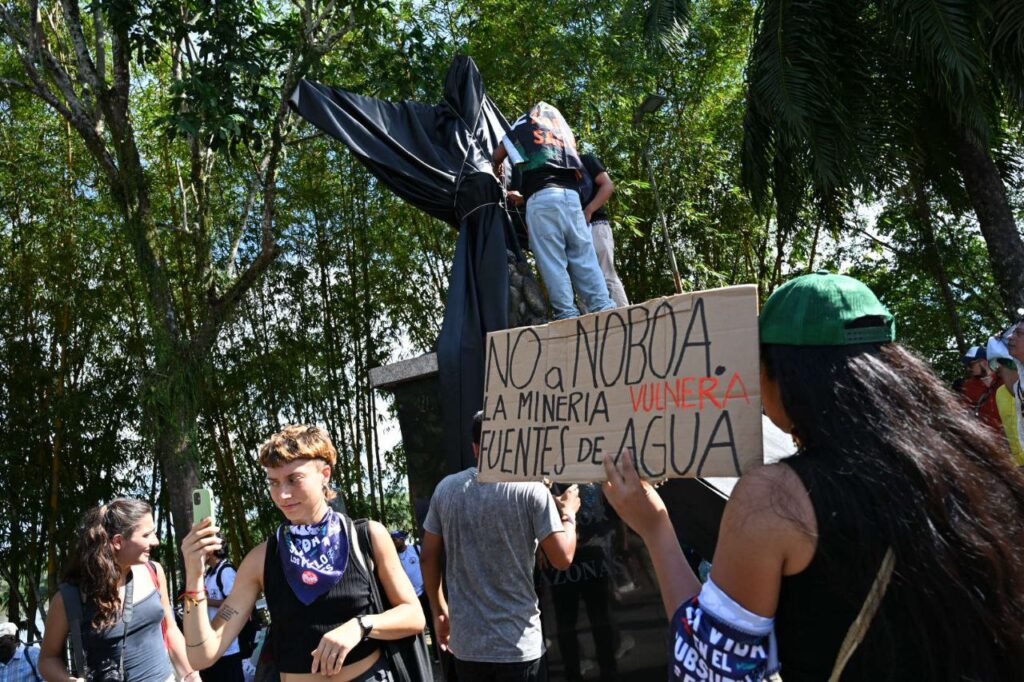
As a closing act for the day, we held the funeral for fossil fuels. This collective action took place in front of the monument to the first colonizer of the Amazon, Francisco de Orellana, which was draped in black. There, we symbolically returned the oil to the ground. Thus, we buried a history of death to sow one of life.
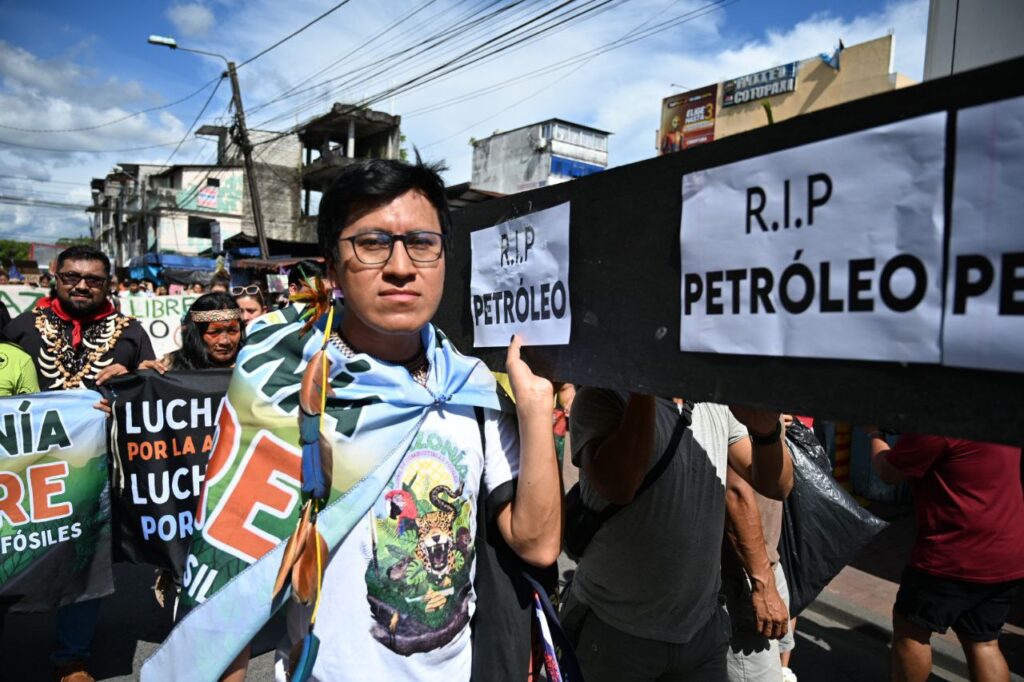
We followed this act with a March for Life, parading through the streets of El Coca with banners, art, a drumline, and slogans, honoring the memory of environmental defenders who have fallen in recent years and demanding the protection of territories, raising the message: “The end of fossil fuels is the beginning of life.” Recognizing and returning to the perfect natural order: keeping minerals underground and life above it.
Official Start of the Flotilla’s River Journey
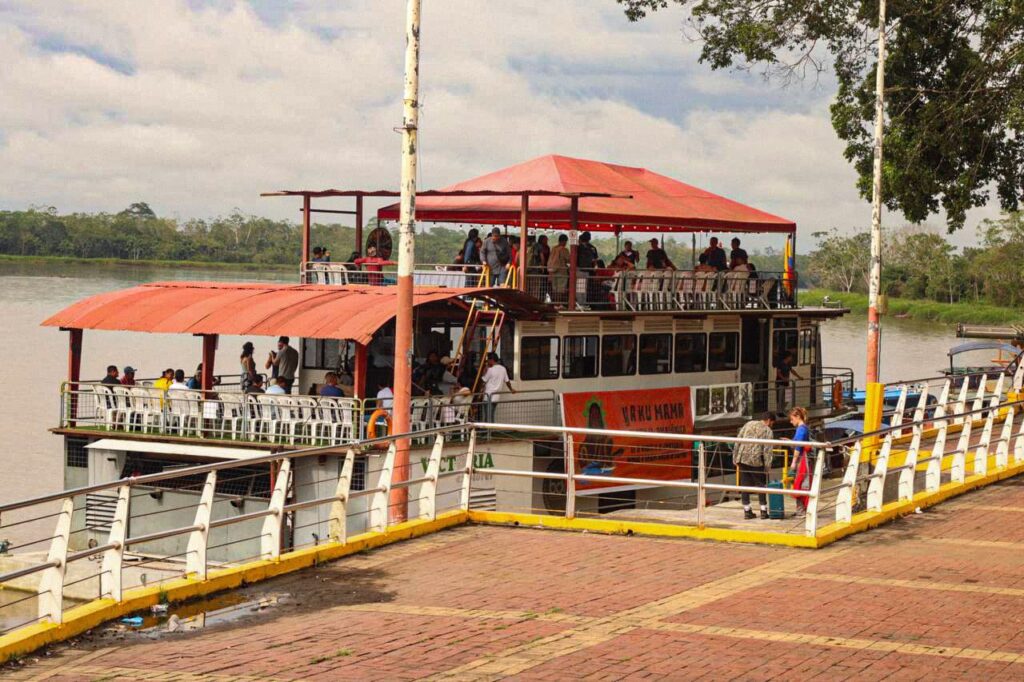
October 16. Port Francisco de Orellana, Ecuador.
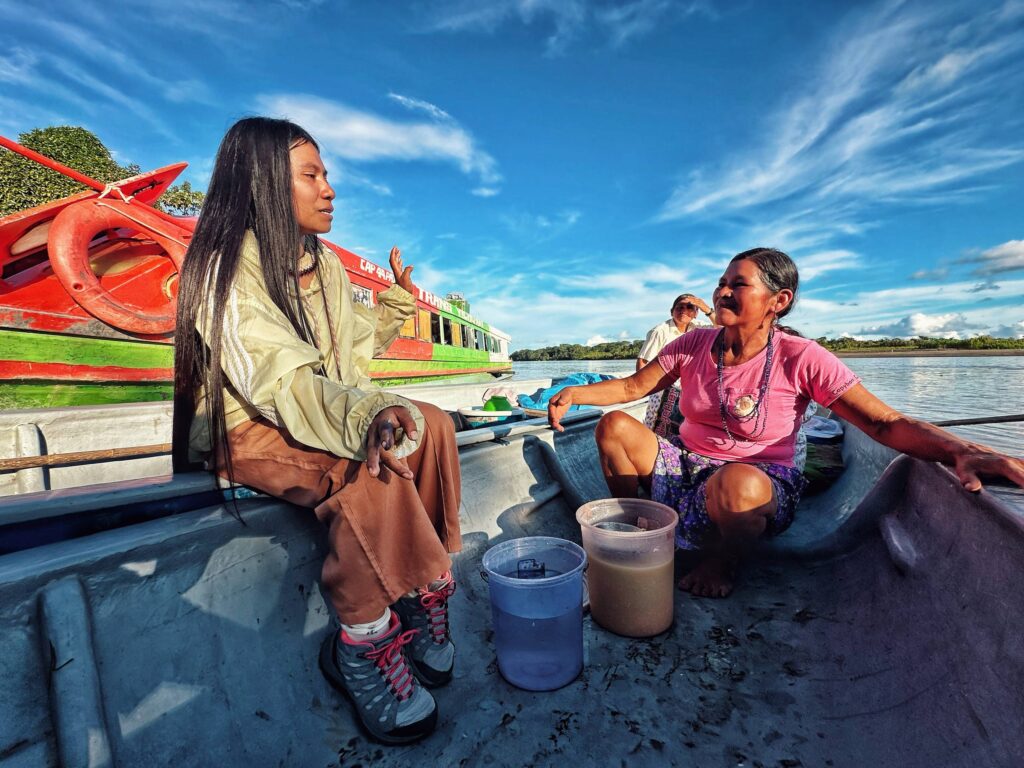
We sorted out the last logistical details, and around noon, we said goodbye to the city of El Coca. The Yaku Mama Amazonian Flotilla set sail from the Napo River, heading for the town of Nuevo Rocafuerte on the border of Ecuador and Peru, our next stop on the long journey to COP30 in Belém.
“This is a call of hope, of solidarity among peoples. We are now heading to the Amazon River, one of the most important rivers that sustain life. We begin by having a space for exchange and recognition of the territories that are on the front lines defending the Amazon rainforest.” – Lucía Ixchiu, Maya K’iche artist and cultural manager.
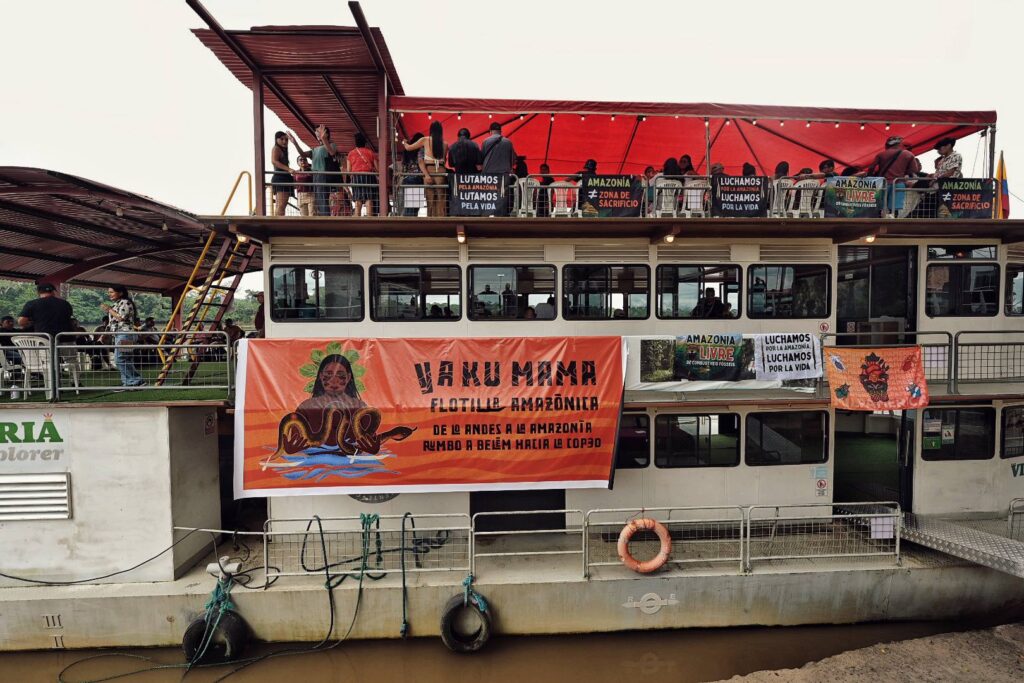
With this symbolic journey, we are reversing the historical route of conquest, transforming it into a path of connection, resistance, and empowerment. We navigate as our ancestors did, to connect the voices of the Amazonian territories and amplify them for the whole world to hear.
“On our route through the rivers of the Amazon, we carry an invitation to life, hope, and reunion, challenging the legacy of violence, exploitation, and colonization. This journey is not one of conquest and extermination but of unity, encounters, and solutions from the territory.” – Leo Cerda, Indigenous leader and activist.
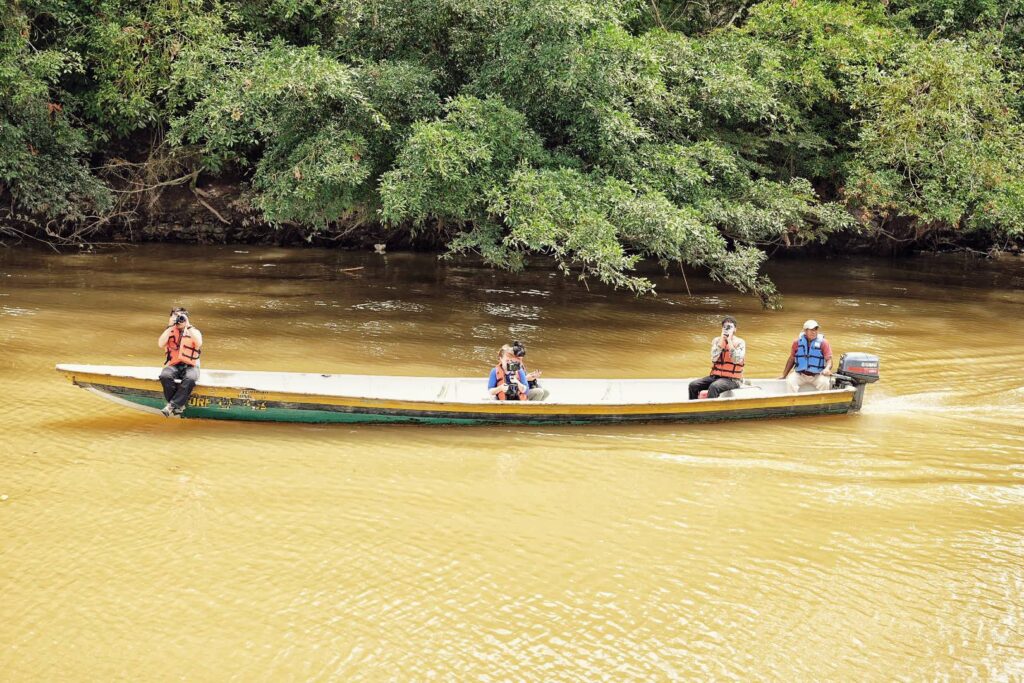
Our flotilla, composed of a delegation of 56 people and more than 60 organizations, will navigate 3,000 kilometers to denounce the scars of extractivism and demand a just and binding energy transition at COP30, which will take place in early November.
Visit to Yasuní National Park
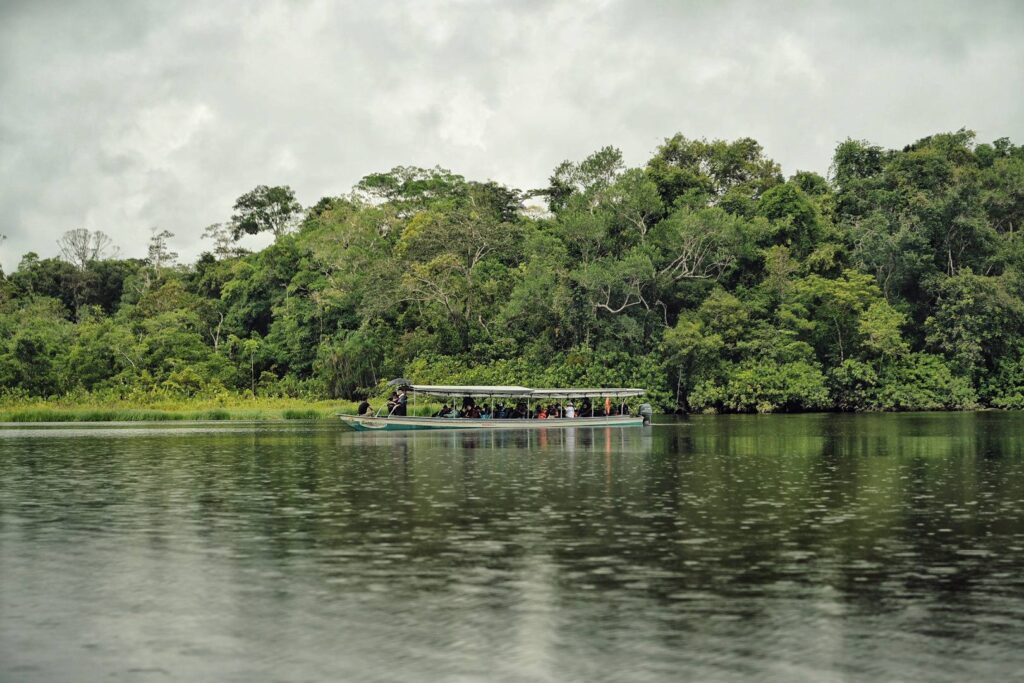
October 17. Puerto Rocafuerte, Ecuador.
After a 6-hour boat trip on the Napo River, we reached the easternmost point of Ecuadorian territory and rested for a night in the town of Nuevo Rocafuerte. The next morning, we completed immigration procedures and toured Yasuní National Park. This is one of the most biodiverse areas on the planet and is recognized as a biosphere reserve by UNESCO. It is also the ancestral home of the Waorani people, a people in initial contact, and the Tagaeri and Taromenane, the latter two being communities in voluntary isolation.
Amid the natural wealth and abundance of Yasuní, we found once again that the greatest threat facing this space comes from oil exploitation, an activity that has been going on for over three decades in the area. Since 1992, Texaco obtained a license for Block 16, and later the license for Block 43 – ITT was added in 2013.
Oil activities have caused the loss of highly biodiverse habitats, deforestation, water contamination, diseases, and a loss of autonomy, according to reports from the Amazonian Network of Georeferenced Socio-Environmental Information (RAISG).
Faced with this reality, in 2007, a historic and symbolic initiative was proposed in Ecuador to leave the oil from the Ishpingo, Tiputini, and Tambococha fields, located within Yasuní National Park, underground, not to exploit it and, in return, to promote an economic fundraising plan to generate income for the country.
After years of joint work between Indigenous communities, Amazonian inhabitants, civil society environmental groups, and the state initiative, in August 2013, the government of Rafael Correa decided to open concessions and oil operations within Yasuní. The response was a tremendous social mobilization and the formation of the Yasunidos collective. A social, civil, and community campaign was immediately organized to hold a National Referendum where all of Ecuador would decide the future of the National Park.
After nearly 10 years of struggle, persecution, and resistance from Yasunidos and the Amazonian peoples defending the rights of Indigenous peoples in voluntary isolation, the referendum was held, proposing to keep the wells within Yasuní National Park unexploited. The result was hopeful: a resounding “Yes” to conserving biodiversity, keeping the oil underground, and protecting the rights of Amazonian communities to a healthy environment.
“After the verification of official results and the support of articulated citizen electoral monitoring, it is verified that the ‘yes’ option reached 5,541,585 votes, which is 58.95% of the total valid votes, becoming the most important national consensus of the last 20 years.” – Official Yasunidos Website
The popular mandate in Ecuador that pushed for the prohibition of the ITT oil project has not yet been fulfilled because, to date, the Ecuadorian government has failed to comply with the block’s shutdown. This is one of the many debts that leaves its scar on the Amazon and reminds us of the importance of our Amazonian Flotilla’s mission and our demand for the end of extractivist activities in Amazonian territories and the preservation of its peoples.
We passed through the immigration offices in Nuevo Rocafuerte, Ecuador, took a one-hour boat trip to Cabo Pantoja, a Peruvian town where we completed immigration procedures, shared a lunch with the community, and in the afternoon, we departed on a Peruvian vessel to continue down the Napo River.
Look out for our recap of the second week of the journey, coming soon.