Destacado

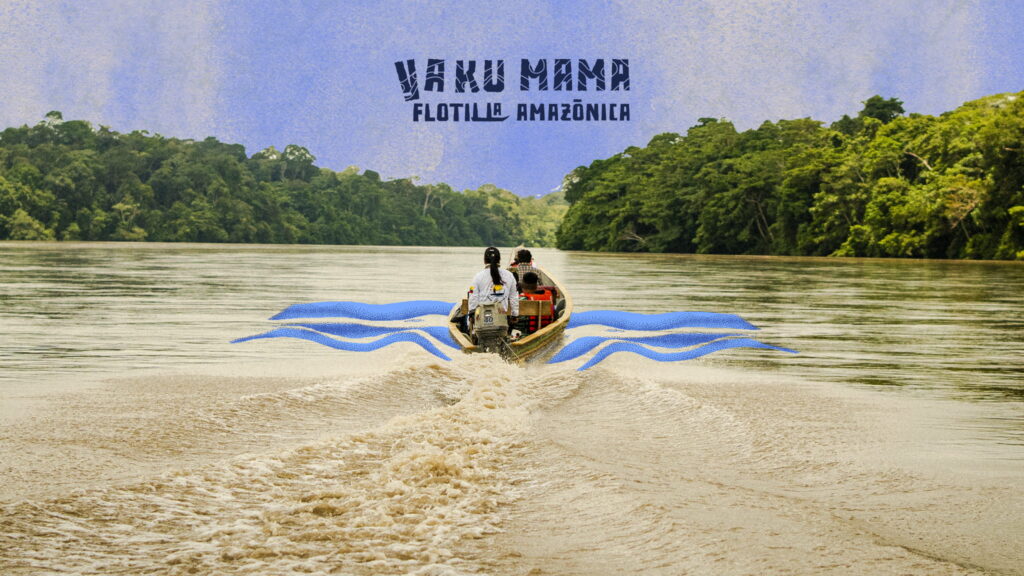
Yaku Mama Flotilla arrives in Belém do Pará for COP30
Destacado, Flotilla

WE ARRIVE AT COP30 WITH A MESSAGE FROM THE HEART OF THE WORLD

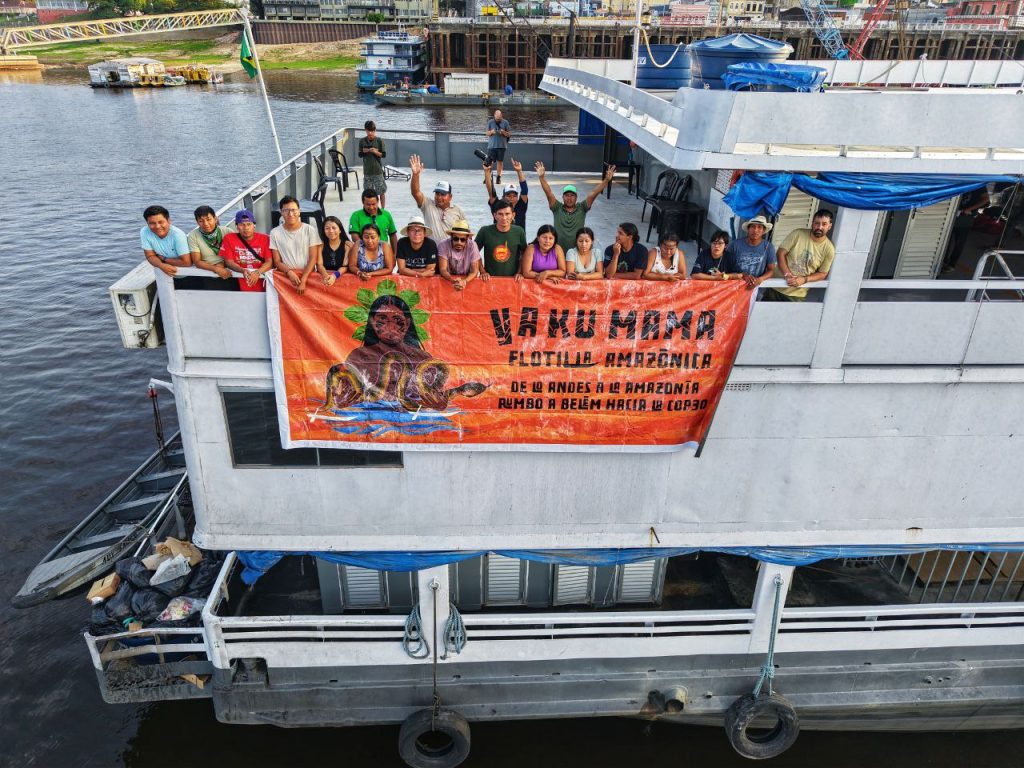
WE ARRIVE AT COP30 WITH A MESSAGE FROM THE HEART OF THE WORLD BELÉM DO PARÁ, BRASIL —November 9, 2025. We are the mountain, the rivers, the living jungle. We are the seeds, the trees, the refuge. We are the territory of all lives. We are the Amazon, we are resistance. We are more than 60 leaders and women leaders of Indigenous Peoples from Ecuador, Colombia, Peru, Brazil, Guatemala, Costa Rica, Panama, Mexico, and Indonesia. For one month, we have navigated 3,000 kilometers along the Napo and Amazon rivers—the same waters that centuries ago were a route of conquest—now transforming them into a path of resistance, dignity, and climate justice. We do not come to COP30 to ask for permission. We come to demand that climate policies be built from the territories, with justice for those of us who protect life. OUR JOURNEY During this journey through Ecuador, Peru, Colombia, and Brazil, the river spoke to us. We saw the blood of the earth in the water: rivers poisoned by illegal mining, oil spills that are never cleaned up, and waste that states have ignored for decades. The water—the primary source of life—is being turned into a threat for those who have protected it for millennia. We witnessed the machine of extermination operating without pause: mining, oil companies, logging, and hydroelectric dams, which continue the 500+ years of ecocide and genocide to fuel the consumption of the Global North, the main responsible party for this climate crisis. We saw defenders forced into exile for protecting life. We saw Indigenous youth blocked: without work or spaces for decision-making, forced to migrate. And we saw the most brutal hypocrisy: Brazil, the host of this COP30, is pushing for oil exploration at the mouth of the Amazon River—home to Peoples in Isolation and Initial Contact. In Ecuador, the government is calling for a constituent assembly to repeal the rights of nature. While the world talks about climate action, it criminalizes and murders those who practice it. COP30 cannot continue deciding about us, without us. COP30 cannot continue to decide about us, without us. THE LIVING SOLUTIONS This journey showed us that viable and replicable solutions already exist—they are alive. At every stop, we exchanged monitoring methods, defense strategies, territorial governance systems, and spirituality. We heard different languages naming the same struggles, distinct worldviews defending the same principle: life is sacred and non-negotiable. We learned from peoples who have stopped extractivist projects through collective governance, who have confronted corporations and states, and won. This flotilla is living evidence: peoples from diverse Ancestral Nations flowing as a single river. We bring communication as a tool for territorial defense, creating our own narrative: territorial authorities with their own voice and legitimate governance systems. We bring the clarity that we are the answer. ot as ‘beneficiaries’ of programs designed in distant offices, but as authorities with the right to self-determination. The results speak for themselves: where Indigenous territory is recognized and respected, the jungle stands tall, the water is clean, and biodiversity thrives. WHAT WE DEMAND AT COP30 Without the Amazon, there is no future for humanity. We arrive in Belém with the following demands and proposals, which are common sense in the face of the environmental, economic, political, and spiritual crisis that the entire world is experiencing. 1. AMAZON FREE OF OIL AND MINING We demand the immediate prohibition of fossil fuel exploration and extraction in the Amazon and in all Indigenous territories worldwide. Only an Amazon free of extraction can guarantee the protection of defenders, preserve biodiversity, and ensure global climate resilience. The Amazon is not a resource to be exploited: it is a living being that requires immediate protection. 2. RECOGNITION OF TERRITORIES AS LIVING BEINGS WITH RIGHTS We demand that States legally recognize the Amazon, rivers, and all territories as living entities with their own rights, not as exploitable resources. This recognition must be translated into effective and binding legal protection. 3. INDIGENOUS TERRITORIAL SOVEREIGNTY ABOVE EXTRACTIVE LAWS We demand the recognition of Indigenous authority as legitimate and binding, superseding concessions and state laws that authorize extractivism. The self-determination of peoples cannot be subordinated to corporate or governmental interests. We demand the recognition and guarantee of full territorial rights. 4. REAL FREE, PRIOR, AND INFORMED CONSENT We demand that the energy transition be truly just, respecting Free, Prior, and Informed Consent without simulations or merely decorative consultations. We demand binding—not symbolic—participation in all negotiation spaces that affect our territories. 5. END TO FORCED EXILE AND EFFECTIVE PROTECTION FOR DEFENDERS We demand justice and concrete security guarantees, and an end to impunity regarding threats, assassinations, and criminalization. We demand an end to forced exile that uproots territorial defenders from their communities. States must ensure that those of us who defend the earth can remain peacefully in our communities. 6. BINDING INTEGRATION OF TRADITIONAL KNOWLEDGE We demand what is rightfully ours: that our ancestral knowledge and practices—applied science spanning thousands of years—be recognized and integrated into climate policies as replicable and globally acknowledged solutions, not as ‘folklore’ or ‘customs. 7. DIRECT FINANCING TO THOSE WHO PROTECT LIFE We demand agile climate funds, without intermediaries who profit from our conservation work, and with simplified access for Indigenous youth. The financing must flow directly to our territorial governance systems and to the new generations of defenders. 8. COMPENSATION FOR CLIMATE ADAPTATION AND CLEAN WATER We demand direct compensation so that Amazonian communities can strengthen their adaptation capabilities to a crisis they did not cause. Our territories are facing droughts, floods, and rivers poisoned by mining and oil. Compensation must include water decontamination, waste management, and investment in adaptation systems based on ancestral knowledge. These demands are non-negotiable because we are not negotiating our existence THE ANSWER IS US This flotilla does not end in Belém. It remains organized and ready to fight. We commit to remaining organized after COP30: to sustain communication and coordination among the participating organizations, and to collectively follow up on these demands

Destacado, Flotilla, News

Amazon Flotilla: Indigenous Peoples Must be at the Center of COP30 Climate Negotiations

Amazon Flotilla: Indigenous Peoples Must be at the Center of COP30 Climate Negotiations An extraordinary journey along the Amazon River just took place. The Yaku Mama Flotilla traveled over 1,800 miles from the Andes in Ecuador to Belém, Brazil, the host city of the next United Nations Climate Change Conference (COP30). This is the first time in history that the COP will take place in the Amazon. Onboard the flotilla were Indigenous leaders, youth, women, and allies, traveling with a shared message: Indigenous peoples must be at the center of climate solutions. Their demands, which include halting fossil fuel extraction in the rainforest, securing direct access to climate finance, and ensuring the protection of their territories and rights, must be heard and acted upon. “The flotilla is a space to share experiences and reflect on issues that are discussed at COPs, but that have historically been addressed without the participation of Indigenous people.“– Alexis Grefa, a Kichwa youth representative from Santa Clara in Ecuador and a member of the flotilla’s organizing team, in an interview with El País Planning for the flotilla began soon after it was announced that COP30 would be hosted in Belém. Indigenous organizations across the Amazon Basin began planting and watering the seeds for a collective journey that would bring visibility to both their struggles and solutions to protect the rainforest. Rather than flying to the summit, they chose to travel by the rivers that connect their territories. And on October 13, the journey began. More than 50 participants from Ecuador, Peru, Brazil, Colombia, Panama, Guatemala, Mexico, Indonesia, and Scotland departed from El Coca, Ecuador. Their boats display the image of Yaku Mama, meaning “Mother Water” in Quechua, a sacred river serpent that symbolizes protection and strength. The route the flotilla took retraced the path taken by Spanish colonizer Francisco de Orellana in 1541. While his expedition marked the beginning of colonization in the region, the flotilla became a journey of Indigenous solidarity and resistance against the continued destruction of the Amazon, the ancestral homes of Indigenous peoples. Before departing down river, the group climbed the Cayambe glacier high in the Ecuadorian Andes to emphasize the ecological connection between highlands and rainforest. In the city of El Coca, they held a protest by covering a statue of Francisco de Orellana as a rejection of the legacy of extractivism and violence he represents. There, they also held a symbolic funeral for fossil fuels in the streets where youth leaders carried a black cardboard coffin labeled “R.I.P. Petróleo.” “We are returning oil to where it belongs, the earth,” said Lucía Ixchiu, a K’iche’ woman from Guatemala, as she lit candles to honor environmental defenders who lost their lives in defense of their lands. Finally, as the flotilla continued toward Ecuador’s border with Peru, they stopped at Ecuador’s Yasuní National Park, an emblematic site of resistance to oil drilling. A Platform for Demands Rooted in Territory Along the way, the flotilla stopped in Indigenous and local communities to share knowledge and amplify urgent demands. These include: These demands from the flotilla participants stem from their lived experience in territories affected by oil spills, illegal mining, deforestation, and harmful infrastructure projects that are relentless. Solidarity Across Borders ainforest Foundation US (RFUS) was proud to support the Yaku Mama Flotilla during its passage through Peru along with our Indigenous partner, the Organization of the Indigenous Peoples of the Eastern Amazon (ORPIO). This collaboration brought participants to communities where they visited community-led sustainable enterprises and learned how community members are using monitoring technology to strengthen territorial defense.  In Peru’s northeastern Amazonian city of Iquitos, the flotilla joined the Floating Amazon Film Festival, where cinema brought to life stories of Indigenous resistance and self-determination. In a Tikuna community in Peru, community members welcomed the participants with dances and songs celebrating life. There, well-known Peruvian Amazonian singer Rossy War joined her voice with those of the Amazonian peoples, reminding everyone that music, too, can heal rivers. The flotilla then continued through the tri-border region of Peru, Colombia, and Brazil, where interconnected territories form the world’s largest contiguous expanse of lands inhabited by Indigenous peoples living in voluntary isolation. These lands are also biodiversity strongholds. In a Tikuna community on the Brazilian side, participants learned about traditional ecological knowledge passed down through generations. Practices in natural medicine, fishing, and peaceful, sustained coexistence with the forest offered living models of a possible future. In Leticia, Colombia, flotilla members met with Indigenous leaders engaged in public policy advocacy. The conversations highlighted the importance of regional coordination amongst Indigenous peoples and the need to ensure that Indigenous voices shape national and international decisions on climate and Indigenous peoples’ land rights.  The Road to COP30 The Yaku Mama Flotilla arrived in Belém on November 9, the day before COP30 began. Its journey through the rivers and territories of the Amazon served as a reminder that Indigenous peoples are key actors shaping the future of our planet. They have managed vast rainforest territories for millennia. These rainforests regulate rainfall, store carbon, and shelter immense biodiversity and sociocultural diversity. In recent years, several studies have provided statistical evidence confirming that lands legally titled to Indigenous peoples are the most effective models for forest protection. “We want to achieve more than just guaranteeing money or financing. We want to reach a consensus where Indigenous territories are no longer sacrificed. This is the COP of the Amazon because we are here, demanding and taking the places that we deserve.”– Lucía Ixchiu, K’iche’ leader from Guatemala told Reuters in an interview  Source: Rainforest Foundation

Destacado

Press Release: The Yaku Mama Amazon Flotilla Embarks on a Historic Journey to COP30

Press Release: The Yaku Mama Amazon Flotilla Embarks on a Historic Journey to COP30 QUITO, ECUADOR – October 16, 2025. The “Yaku Mama Amazon Flotilla“ is launching a symbolic journey from the city of Coca in Ecuador to demand a new paradigm: placing the Amazon at the heart of the fight for climate justice and promoting an end to fossil fuel extraction and use. Connecting the Andes to the Amazon, a coalition of 60 Indigenous and territorial organizations, alongside allies from around the world, will travel more than 3,000 kilometers toward COP30, to be held in Belém, Brazil, in early November. This journey is not just an act of protest but a powerful demand: climate justice must become a reality, and fossil fuel extraction in the Amazon must end now.  The flotilla participants previously gathered in Quito as a starting point. This choice was not merely symbolic but sought to confront history: it was from this city, in 1541, that Francisco de Orellana’s expedition departed, culminating in the ‘discovery’ of the Amazon River. Today, the “Yaku Mama Amazon Flotilla” symbolically reverses that route of conquest into one of connection, honoring the resistance of Indigenous Peoples and the first continental uprising of 1992, with the goal of making the world finally listen to the voices of the territories. “This journey is an act of resistance and empowerment that links the climate crisis to its colonial and extractivist roots, positioning the peoples who have contributed least to it as the most affected. It is an urgent call to COP30 to recognize that true climate justice is born from the land, flows with its rivers, and is sustained by those who protect it,” stated Lucía Ixchú, a Maya K’iche’ Indigenous woman from Guatemala and spokesperson for the flotilla. To begin the journey, the flotilla’s crew, together with ally organizations, will hold a symbolic funeral to bid farewell to the era of fossil fuels that has devastated the Amazon. This collective action denounces the false solutions that, in the name of the energy transition, continue to impose extractive projects and new sacrifice zones on Indigenous territories. In response, the Amazonian peoples reclaim their right to decide over their territories and to lead the way toward a just and living transition without creating new sacrifice zones through mining, oil spills, and monocultures. The Yaku Mama Amazon Flotilla demands a truly fair and binding energy transition. Indigenous Peoples urge governments and companies to ensure that any clean energy project respects Free, Prior, and Informed Consent (FPIC) and puts an end to fossil fuel developments that jeopardize their territories and ways of life. At the same time, they call for the recognition and protection of intangible zones for Indigenous Peoples in Isolation and Initial Contact (PIACI), whose existence and well-being depend on territories free from exploitation. Protecting these forests not only guarantees the survival of these peoples but also preserves biodiversity, maintains global climate balance, and ensures the quality of life for all inhabitants of the planet. The journey begins at a critical time for the Amazon. According to a report presented by the Monitoring of the Andean Amazon Project (MAAP) last year, 2024 marked a devastating record with the loss of 4.5 million hectares of primary forest due to deforestation and fires. This destruction is driven by the advance of extractivism; the same study reveals that deforestation from gold mining has increased by over 50% since 2018, with 36% of it occurring within protected areas and Indigenous territories. The River That Flows: from History to Hope “We are in Ecuador today for a very specific reason. Centuries ago, missions departed from Quito that claimed the ‘discovery’ of the Great Amazon River, bringing conquest to our territories,” affirmed Leo Cerda, a Kichwa Indigenous person from Napo, Ecuador. “We too have come to Quito, that historic starting point, to reclaim this route. And on October 16th, from Francisco de Orellana—the city of Coca—we will embark on a new journey that honors the memory of struggle and resistance of the Amazonian Indigenous Peoples. We also dedicate this journey to the memory of October 12th as a symbol of the resilience of the Peoples of the Americas. We set out not to conquer, but to connect; so that the world, finally, will listen to the voices of the territory,” he added. The flotilla is composed of a delegation of fifty people, including representatives of Indigenous peoples and civil society organizations from the Amazon, Mesoamerica, the Republic of Congo, and Indonesia. It will travel the Amazon River to denounce the “scars of extractivism”—such as illegal mining and deforestation—and, at the same time, highlight the strength of the living alternatives in their communities, such as productive enterprises, territorial monitoring, and ancestral science. The Era of Fossil Fuels in the Amazon Must End Fossil fuels not only harm the environment; they are a driver of social violence.  Worldwide, especially in the Amazon, defending the territory has become a death sentence. According to the latest report from Global Witness, published in 2024, between 2012 and 2024 alone, at least 2,253 defenders have been murdered or have disappeared, 40% of whom were Indigenous. Violence against the Amazon is manifested in the silent expansion of the oil and fossil gas industry. Between 2012 and 2020, the number of exploitation fields increased by 13%, and today, extraction is present in eight of the nine Amazonian countries. According to InfoAmazonia and Arayara, oil exploration overlaps with 441 ancestral territories and 61 natural protected areas, devouring the rainforest and directly threatening the lives and self-determination of Indigenous peoples. Across the Pan-Amazon, there are 933 oil and gas blocks, of which 472 are in Brazil, 71 in Ecuador, 59 in Peru, and 47 in Colombia, many located within protected areas or Indigenous territories. The impact of this industry is devastating: between 2000 and 2023, Peru recorded 831 oil spills, and Ecuador, 1,584 between 2012 and 2022. In Brazil, the attempt to open a new oil frontier at the mouth

RESULTS OF THE INDIGENOUS PRE-COP
Destacado

Calls To Action From Indigenous Peoples for COP30

Calls To Action From Indigenous Peoples for COP30 1 Recognition and protection of all indigenous territories, especially territories with the presence of Indigenous Peoples in Isolation and Initial Contact (PIACI), as climate policy and action For Indigenous Peoples, the territory goes beyond a physical space — it is a sacred place where all beings coexist in harmony, uniting the spiritual and the material, the individual and the collective, the past and the present. It is in this integral relationship with the land that good living and a full life are built, essential for the preservation of the planet. The demarcation and full protection of indigenous territories, especially those where the PIACI are present, are effective climate policies that guarantee our rights and strengthen biodiversity conservation and climate balance. 2 Direct financing and financial autonomy Financial mechanisms, including those of the UN Framework Convention on Climate Change (UNFCCC), must include and prioritize mechanisms for direct access to resources for IndigenousPeoples, strengthening our own organizations, funds, and strategies to mitigate, adapt, and combat loss and damage. We demand that the financial architecture of the UNFCCC include our indigenous organizations and our own financial mechanisms, such as existing indigenous funds, for the allocation of resources aimed at climate mitigation, adaptation, and combating loss and damage in indigenous territories. 3 Representation and effective participation Ensure in all climate decision-making spaces, including those at COP30, the full, equitable, inclusive, effective and gender-responsive representation and participation of Indigenous Peoples in decision-making. It is critical to ensure that this representation derives from our own systems of government. 4 Protection of indigenous defenders The safety of leaders and defenders who protect the forest must be an essential part of climate policies. 5 Inclusion of Indigenous knowledge systems Our Indigenous knowledge systems and sustainable ways of life must be recognizedas legitimate strategies for mitigation, adaptation, and environmental restoration. 6 Exploitation-free zones in indigenous territories We demand a decree establishing indigenous territories as areas free from extractive activities, in order to protect life, rights, and ecosystems.

Yaku Mama Caravan
Destacado

DECLARATION WE SAIL UNITED FOR CLIMATE JUSTICE

DECLARATION WE SAIL UNITED FOR CLIMATE JUSTICE We, Indigenous Peoples, organizations, movements, and coalitions from Abya Yala and around the world, defenders of nature, the Amazon, and our rights, gather today in Quito for a clear reason: centuries ago, from this city, departed the missions that, under the pretext of ‘discovering’ the Great Amazon River, unleashed conquest upon our territories and the entire Amazon. Today, from this very same point, in memory of October 12th—the beginning of the colonization of the Americas—and in commemoration of the first great uprising of Indigenous Peoples across the continent in 1992, we begin a new chapter. We set out not to conquer, but to connect. We set out so that the world may finally hear the voices from our territories. On the eve of October 12, a date that marks centuries of dispossession, we present the Yaku Mama Amazon Flotilla, a coalition of peoples, communities, organizations, and movements uniting to travel 3,000 km from the Andean glaciers of Ecuador to Belém, Brazil, for COP30. United as one body—the Andes, the Amazon, and the world’s forests—we sail to remember that the life of the planet depends on the protection of our territories and our rights. We sail to remind the world that true climate action is not signed in agreements—it is lived and defended in our territories every day. We sail to tell the world that the Amazon and our Indigenous and collective territories are the heart of the global climate response. This journey is diversity in motion. At each stop, we will show the scars of extractivism—illegal mining, oil spills, false climate solutions—and we will also reveal the strength of our alternatives: the living forest economy, ancestral science, and collective governance. We are not going to Belém to ask for a seat at the table; we are going to demand that climate policies be built from the territories, with justice for those of us who protect life. OUR DENUNCIATIONS OUR PROPOSALS AND DEMANDS We sail from the middle of the world to shift the center of decision-making from boardrooms to the territories, because true climate justice is born from the land, flows with its rivers, and is upheld by those who protect it. Declaration issued worldwide on October 9, 2025 Signatories:

Scroll to Top
Privacy Overview

This website uses cookies so that we can provide you with the best user experience possible. Cookie information is stored in your browser and performs functions such as recognising you when you return to our website and helping our team to understand which sections of the website you find most interesting and useful.